Praise for My Books


"Manreet Sodhi Someshwar is a gifted writer of great promise. I have a gut feeling we have a new star rising in Punjab's literary horizon. She has an excellent command of English and a sly sense of humour."
- Khushwant Singh on The Long Walk Home

"An enjoyable tale of a sassy girl's headlong race up the corporate ladder."
- India Today on Earning the Laundry Stripes


Wednesday, 25 May 2011

Of Sugar and Spice ...

So folks, I was getting ready to hunker down at my desk for another day of writing when research took me to google the omniscient, and, voila!, I stumbled upon a coverage in The Hindu of my debut novel: Earning the Laundry Stripes.

Writers approach book reviews with trepidation, and rightfully so. As someone said, the decision to have a child is to forever let your heart walk outside your body ... Well, substitute 'child' for 'book' for what else is the process of writing but creation?! And books like children do acquire a life of their own.

So, as I was in the midst of this third book/creation of mine, I came across this delightful review and a warm feeling filled me up. A bit like your moppet returning from school with a report card, which, jeez - mercifully - says things are in order!

"At one level it is a racy narrative which can engage you through the journey of Noor across India's dusty and chaotic hinterland with their ... to a sensitive, searing account of the complex realities of an India divided along gender, communal, class and regional lines. "

Read the complete article below, or at The Hindu

It was published in November 2006 and some of you might have missed it. The book is still available in bookstores in India or you could order it online at Amazon, Flipkart, Friends of Books ...

Enjoy!


Of sugar and spice...

SHARE  ·   PRINT   ·   T+  
The first woman Sales Manager in HLL, Noor Bhalla flounders initially, but soon learns that the best way to do her job is to use her inherent strengths as a woman.
Earning the Laundry StripesBy Manreet Sodhi Someshwar Publishers: Rupa & CoPrice: Rs 195
Rasheeda Bhagat
The five women in the Gujarati distributor's house spend most of their time in the kitchen, and are the first to rise and last to sleep. Says the grandmother with obvious pride: "Feeding a family of 15 is like feeding an army".
The most appealing aspect of Manreet Sodhi Someshwar's
Earning the Laundry Stripes
(published by Rupa & Co) is that it can hold a reader's interest at different levels. The author has transferred her real life experiences sometimes fulfilling but most often harrowing as the first woman ASM in sales at Hindustan Lever Ltd to the protagonist Noor Bhalla. An engineer-cum-MBA (IIM, Calcutta), Noor finds herself in a man's world of sales and is totally at odds with a milieu where her male colleagues watch porn films before presentations or attack liquor with gusto at office parties.
At one level it is a racy narrative which can engage you through the journey of Noor across India's dusty and chaotic hinterland with their
loos
(hot winds of Central India), distributors with their own set of idiosyncrasies who are totally taken aback at the prospect of having to deal with a woman in sales, and the `policeman' More, who blackmails her saying that the man she had thrashed with her handbag filled with a couple of kg of Rin bars, because he had molested her in a public transport bus, was in a coma and might kick the bucket any day.
Noor's journey is interspersed with sexual innuendos from her colleagues and distributors alike, beginning with an old man in Sales at Bombay HLL lecturing her on what misfits MBAs would be in rural sales, and how the "trade retail/wholesale is
manned
by men." As he holds forth on how sales is a "frontier province that requires lean and keen men", he suddenly stops to inquire about her name. `Noor' would make her a Muslim, but `Bhalla' was obviously Punjabi; this puzzles him.
Here is what Manreet's Noor wants to tell him, but of course doesn't: "I am a Punjabi Sardarni who chews screwballs and spits them out. For fun. But what if I were Muslim?
Hanh
?
Hanh
?"
Such passages display the female sales executive's chagrin at personal questions being thrown at her all the time and the communal divisions that rule people's heads and hearts.
The feminist angle
Along the way, as she takes on a myriad of HLL distributors in the hinterland, or accompanies a
firang
HLL executive with élan around Bombay, impressing him with her competence and knowledge, she is devastated to discover the little value that her gender has in rural India. To the extent that in a village in Uttar Pradesh when asked about the number of children the women have, the reply given includes only sons; daughters, apparently, don't count as "children". As their local companion Ram Singh explains: "Daughters are
paraya dhan
from the day they are born all their fathers can do is to collect their dowry... Out of helplessness, some resort to
datura
(poisonous seeds to kill them)".
This is another level of the book, where Manreet the feminist comes through with a sharp focus. Take this passage when a senior colleague gives her another lecture on how incompatible it would be for a woman, "whose whole life" revolves around marriage and children, to be in sales, and advises her to opt for "market research" instead!
When he learns she has a South Indian boyfriend, he goes into a tizzy and says: "You have a penchant for problems", following it up with a
bhashan
on how men are different as boyfriends and husbands.
But as a woman sales executive Noor faces moments of triumph too. In the Gujarati distributor Govindbhai's house, after a meal when she resorts to her trump card of being able, as a woman, to go to the kitchen and talk to the women, she finds that there are five women between 17 and 70 there. They spend most of their time in the kitchen, and are the first to rise and last to sleep. The grandmother informs her with obvious pride that "feeding a family of 15 was like feeding an army", and how she is preparing her granddaughter studying in Class VIII for the task of taking over the kitchen in her husband's house some day!
But Noor is delighted when Govindbhai tells her the girl "is keen to meet a real lady manager as she has never seen one before. You see, she wants to be an engineer when she grows up." And Noor is reminded of the little girl in Etha, UP, "who at eight years, is a surrogate mother and housekeeper; a girl child who will neither get a chance to be a girl or a child".
Communal polarisation in India
Yet another layer of the book mirrors the author's distress at the increasing communal polarisation in India. At an HLL distributor's place in Bombayshe runs into Imran, the child who had watched his entire family being electrocuted to death in the Gujarat riots. The shock turns him into a mental retard. But imagine her horror when the distributor bitterly tells him that he had put his nephew away in a home because the terrorists wanted to use him as a suicide bomber. "The riots had already made the boy an idiot, they claimed. Why not put him to good use? Strap a belt of explosives around him, leave him in the middle of a crowded market and remote-detonate the bomb. Then watch the Hindus die."
Noor also has to contend with communalism at home; her mother is against her marrying the Hindu Siddharth, and says: "Marriage is different from friendship. After blood ties, the ties that count are those you make within your own community. Daily we are seeing riots in India: Hindu-Muslim, Hindu-Sikh, Hindu-Christian because the majority community wants to impose their faith on the minorities. Do not abandon your faith."
Her mother's desperate plea leaves her with many emotions, a prominent one being of the "little boy (Imran) who had screamed in my face and drilled a hole forever in my heart. A little boy who was graded `ammo' in yet another fight for faith."
These are the passages that elevate Manreet's novel from a mere narration of a woman sales manager's travails in a man's world, to a sensitive, searing account of the complex realities of an India divided along gender, communal, class and regional lines. Her ability to deftly mix sensitive and serious issues like gender and communalism with a lot of
masala
, such as finding herself staring into the eyes of a crocodile as she is stranded in a Sumo in flooded Baroda street, her encounters with the colourful More, tales of her batch-mate Kalpana's boyfriend pawing other women, etc, makes the book an absorbing read.
But the punch line is in her discovery that as a woman she can bring special insights into sales and had floundered because she had been looking at it all along from the male point of view. In her learning to "play off my inherent strengths a woman is just so much better than men at some things" lies her nirvana.
Response can be sent to rasheeda@thehindu.co.in

Wednesday, 18 May 2011

Crossing the Line


On Sunday, the IMF chief and potential French presidential candidate, Dominique Strauss-Kahn, was arrested by the police for sexually assaulting a maid in his hotel suite in New York City.

Less than two years back, in a similar high-profile case, a Bollywood film star, Shiney Ahuja, was arrested for assaulting his maid in his house in Mumbai during his wife’s absence.

Why do powerful people inexplicably cross the line into deplorable behaviour?

In his Ballad of East and West, Kipling famously spoke about the two antipodes not meeting until Judgement Day. Perhaps, he should have added a caveat: or when they face a person they deem powerless.

The above two incidents can be linked in a chain that extends to Abu Ghraib – the infamous Iraqi prison where US military personnel carried out torture and abuse of the inmates which became public in 2004.

Some understanding of this phenomenon can be gleaned from a psychological experiment conducted in 1971 by professor Philip Zimbardo. In what is known as the Stanford prison experiment, twenty-four students were selected to play prisoners and live in a mock prison in the basement of the University Psychology building. Roles were assigned randomly.

The experiment, which was filmed, was planned for two weeks. However, it was abruptly stopped after only six days. The participants adapted to their roles so well that ‘officers’ carried out actual physical abuse of the ‘prisoners’ who succumbed into passivity.

A key conclusion of the experiment was what Zimbardo called the pathology of power: when people believe they are powerful and do not have to justify their actions to any one, they will invariably abuse that power.  He worked with the defense team of lawyers representing a soldier accused of abuse at Abu Ghraib. Arguing that rather than a case of a “few bad apples” as explained by the military officials, it was systemic failure which resulted from an unregulated and authoritarian incarceration system.

While there are those who argue with Philip Zimbardo’s conclusions we would do well to reflect on the manner in which the roles of the powerful impact their conduct.

The IMF oversees the global financial system and its chief, consequently, has a high degree of influence in world affairs. No wonder Strauss-Kahn, nicknamed “The Great Seducer” by French media, thought he could force himself on an unsuspecting maid – a single mother of African descent – who was much lower in the power hierarchy. Apparently she has identified him in a police line up but he, who departed the hotel in evident haste and was apprehended from a plane waiting to take off, will reportedly plead not guilty.

In India, it is joked that there are three Gods: cricket gods, film gods, and God gods. No wonder Shiney Ahuja is still to be convicted. His maid has retracted her statement and the accused is out on bail. It is generally believed that she was coerced or bribed.

I don’t know about holes in Philip Zimbardo’s theory but I do know about roles. The Indian tenets of dharma and karma have resulted in a society built on a hierarchy of set roles and concomitant expectations. Over time these have devolved into pejorative pairs: woman-submissive; caste-discrimination; politician-corrupt; judiciary-delay …

However, as India changes, people have begun to question the established roles. Recently, an anti-corruption call by a social worker garnered such support across the country that the Government was forced to accept his demand.

With India’s growth, crimes against women have become a growth industry too. Delhi, which ranks number one in crimes reported against women, has seen a new initiative launched by the police: a make-at-home version of pepper spray, Mirchi Jonkh, literally ‘chilli burst’, to help women fight assailants. Police have distributed empty spray bottles with pamphlets explaining the method of preparation, both in Hindi and English.

The deputy commissioner of police has stated that in view of the increasing crime rate they had increased police presence but realized self-defence was the answer.

In a culture where women are traditionally told to look the other way when faced with lewd male behaviour kudos has to be given to Delhi police. They have subverted the meek role expected of women, arming them instead with the powerful notion that they aren’t helpless. And equipping them with a handy tool too.

Perhaps the management of Sofitel hotel will consider arming their maids with pepper spray. A burst of chilli in the eyes would have sent “The Great Seducer” scurrying back to the bathroom.


Monday, 16 May 2011

A great story never ends where it is expected to!


For me, the great pleasure of a well-thumbed, much-loved book is that when I am busted after a day of writing, or when I just want to read someone other than myself (the travails of a writerly life, eh!), I pick up one such friend.

Recently, I was browsing through The Hakawati, and was joyously rewarded for my effort. It is a lush luxuriant book, filled with nested narratives, and transports you to a new land - what more can you ask of any friend?

I reviewed it for the SCMP when it was launched, loved it and am sharing the review here. If you want to earmark a book for the long summer days, let it be this!  


The Hakawati
by Rabih Alameddine
Picador
HK$ 208
****
Manreet Sodhi Someshwar
FICTION


To represent The Hakawati as a sprawling epic would be limiting; to liken its narrative to a set of nested Russian dolls would be prosaic; to describe the prose as inventive would be an understatement – what then is The Hakawati? The bare facts: It is the third novel of Rabih Alameddine, a Lebanese-American writer, who took eight years crafting its 513 pages. In Arabic the title means storyteller and the novel is a contemporary Arabian Nights. Now, for the juice: a luscious Lebanese meze rustled up from the Quran, the Old Testament, Levantine folk tales, Panchatantra, the Thousand and One Nights and shot through with a narrative of a young émigré returning to his native Lebanon, The Hakawati is storytelling on steroids.

Beginning with the simple instruction – Listen – the novel opens with the story of an emir who has everything he desires except for a son. He consults his vizier and on his advice packs off his slave girl Fatima to Egypt to fetch the miracle cure. This saga intertwines with the story of Osama al-Kharrat who has returned from US to Beirut to his dying father’s hospital bedside. The war-ravaged city has changed beyond Osama’s recognition; childhood friends have grown up into selves as varied as militiaman, sycophant, femme fatale, businesswoman; and the large family has unravelled. But it is Eid-al-Adha, the traditional time for a family feast, and since the patriarch is bedridden an elaborate home-cooked meal is rolled into the hospital room on a gurney amidst gossip, laughter and stories.

As Osama’s feisty sister Lina, pregnant niece Salwa, best friend Fatima, obsequious cousin Hafez, and Aunt Samia hover about the hospital in concern, the narrative bubbles with their individual stories. Mingled with these are Osama’s reminisces of his grandfather Ismail – the original Hakawati of the story, his father Farid and his favourite uncle Jihad. And how, despite his father’s disapproval of the grandfather’s lowly storyteller’s profession – that had earned the family name al-Kharrat, fibster in Arabic – Osama was weaned on stories by the old man. Through the tangled skein of individual idiosyncracies, personal privations and lost loves emerges a microcosm of Lebanon during its independence, civil war and reconstruction.

The Hakawati is Alameddine’s Rushdiesque paean to the place of his birth. His invigorating tales of love, lust and longing juxtapose gentle pigeoneers with the adventurous Mamluk slave King Baybars, nosedive into the Biblical saga of Abraham, Sarah and Hagar and take flight with the fabulist fantasies of demons, imps and magic carpets. “Reality never meets our wants, and adjusting both is why we tell stories," observes a character in the novel, and as the novel proceeds the reader begins to glean the leitmotif coursing through the web of stories. It becomes apparent that sometime in his growing-up years Osama had fallen out with his father Farid, the relationship thereon marked by a stony silence.

Now, as Osama keeps vigil over his prostrate father, the only way he knows to communicate with him is through stories. Like a contemporary Sheherazade, Osama attempts to stave off his father’s death through the narration of myriad tales. Thus the story loops back to the beginning, the first and last word being the same – Listen – and one realizes that all along the Hakawati was none other than Osama.

The book could have done with tighter editing, the buffet table sags under its sumptuousness. That quibble aside, reading The Hakawati is like embarking on a steam engine train to a wondrous terrain – surrender to its meanders, forget the destination, and you will discover, as a character quips, “A great story never ends where it is expected to”.

Sunday, 8 May 2011

Art versus the fundoos, and the connect between Bin Laden and Munni


Apparently Bin Laden forbade music, television, refrigerator – considering he was looking to revert to and preserve a seventh century Caliphate, some empathy with the process of refrigeration would be normal, no? – air conditioning, toys …  In her memoir, Growing up Bin Laden, his first wife says how “everything lively was banned”.
Which brings to mind another bigot, the Mughal emperor Aurangzeb who on ascending the throne proceeded to ban music and dismiss court musicians. His reign was marked by constant warfare and upon his demise the kingdom unraveled. There are historians who claim that the ban on music was a factor that led to his downfall, the cultural repression exacerbating the rebellions against his rule.
On an aside, when planning Operation Geronimo, did the SEALs think of bombarding Bin Laden with a streaming video of ‘Munni badnaam hui’ – the emanating liveliness might just have proved catatonic …
Clearly, art and artistic endeavours are inimical to bigots/terrorists/fundoos. (For those readers unfamiliar with the word, fundoo is an Indian slang for anyone who holds rigidly fundamentalist views, regardless of their religious affiliation – the word is inherently secular!)
            So the question naturally arises: why do fundoos hate art?
            Can the answer lie in the examination of an artist’s life? In order to glean the answer I turned to two artists I admire tremendously. 

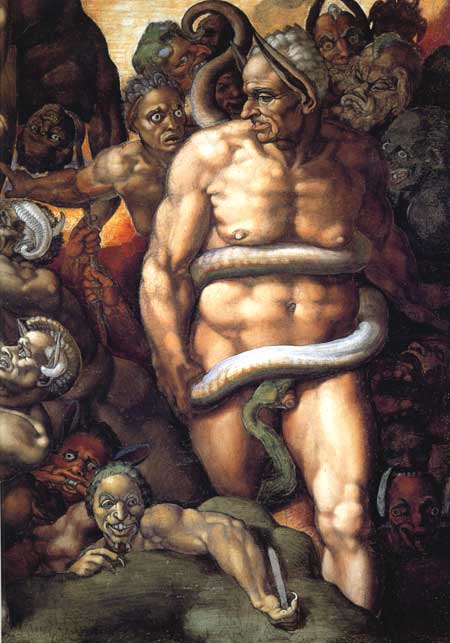
Michelangelo Buonarroti (1475-1564) is widely regarded as one of the three Renaissance greats along with Leonardo and Raphael. If there’s any doubt to his enduring legacy, one visit to the Vatican will put paid to any such misgivings. The main doorway of the Vatican Museums is surmounted by two statues of great artists in recognition of their contribution to the treasures of the Vatican. A young man holding a palette and brushes is Raphael and an elderly man with a sculptor’s mallet in his hand is Michelangelo. 
The Sistine Chapel ceiling painted by Michelangelo is one of the most renowned artworks of the Renaissance period. As is The Last Judgement, a fresco painted by him on the altar wall of the Sistine.
Biagio Martinelli da Cesena was the Pope’s master of ceremonials. When Michelangelo was painting the Sistine Chapel wall Biagio criticised the nudes as immoral. Michelangelo, however, was magnifying the Creator’s work by illustrating his finest creation, Man, in his pristine form. Besides, the fresco was depicting Resurrection of the dead, and surely, they would not arise from their tombs in clothes! Nonetheless, Biagio persisted with his criticisms. The fresco was nearing completion when Michelangelo was painting Minos, a mythical King at the entrance to Hell. Tired of Biagio’s carping, he gave his profile to Minos, with two ass’s ears and a serpent’s head biting the poor man’s private parts.
The Last Judgement was painted 500 years ago. Each year, millions of Vatican visitors gaze at the Sistine chapel wall. Both the painter and his critic are long dead but Biagio da Cesena has remained forever the guardian of Hell, and an enduring gag on the Vatican gig!

Closer home let’s turn to Bulleh Shah.
Many people became aware of Baba Bulleh Shah when Rabbi Shergill shot to the top of music charts with his rendition of ‘Bullah kee jaana main kaun’. Baba Bulleh Shah (1680-1757) lived in Punjab at a time of communal strife. Bulleh Shah was a humanist, a Sufi poet and philosopher who used a verse form called Kafi, a style of poetry popular with Sufi and Punjabi poets. His poetry uses metaphors from daily life to addresses issues of religious orthodoxy, spiritual journey, and the nature of man.   
When he died his body lay unburied for several days since no cleric was willing to perform the burial rites of a heretic. Fast forward to today and earlier in the year a similar situation was observed when Salman Taseer was shot dead by his bodyguard and leading imams in Pakistan refused to lead funeral prayers for the assassinated Governor. I blogged about it here.
            Bulleh Shah the iconoclast is dead, his critics in contemporary avatar can be found amongst the modern-day fundoos and yet his Kafi has such resonance with people that his songs top the charts frequently in South Asia. He is sung by street singers as well as fusion rock bands. Bollywood finds inspiration in his Kafi: Chaiya Chaiya, the chartbuster from Dil Se, takes off from Tere Ishq Nachaya Kar Ke Thaiya Thaiya …

Your love made me dance like crazy
Falling in love with you
was like taking a sip of poison …

            If you are new to Bulleh Shah, I’d suggest listening to this rendition by Abida Parveen. Don’t attempt to comprehend. Find a comfy spot, sit back and let the notes wash over you – the Kaafi shall reveal its magic to you, I promise.  
            The great thing about art is that it influences us without our being aware of it –And thereafter we carry it around as an imperceptible part of ourselves. That is the enduring legacy of art.

It is said that Hitler was very keen to be a painter. However the portfolio he submitted to the prestigious Vienna Academy of Fine Arts failed to get him admission. He became a drifter in Vienna where anti-Semitism was to slowly emerge as the core of his world view.
Moral of the story: don’t mess with an artist!

So, is there a piece of art that moved you, made you pause and ponder, made you lose count of time? One that you carried back with you, and that breathes with you? Tell me about it.
As for me, I shall go listen to Abida sing Tere ishq nachaye and dance like crazy!

Wednesday, 4 May 2011

The Honourable Killing

My award-winning short story, The Honourable Killing, is now available on Kindle at a special promotion price of 99 cents only.

The Honourable Killing is a powerful 1500-word short story, an edited version of which won a Commonwealth Broadcasting Association prize in 2005.


A rape victim in arid Balochistan struggles to bring her culprits to Court - until she realizes justice might well be in her hands.


So, if you're the lucky possessor of an ipad or a Kindle or any other electronic reading device, what better time to read it than now?!

And here's a sneak peek to get you started.


Mukhtar rose early, surprising her rooster as she slipped outdoors. The air, rested by a night’s sleep, was crisp and light. She paused for a moment to breathe it in, her thin shoulders squaring. Later, the fierce warrior of the Plains, the Sun, would toast it and send everybody scurrying – from Alexander’s mighty army hundreds of years back to the burly tribal bullies of today. Pre-dawn was precious time. Hunching forward, she picked her way through the unlit bramble.


The steel pipe rose from the shrubbery, an eerily glistening python aloft concrete stumps. She looked back and surveyed the brush in which stood her two-room abode – a juniper shrub caught her eye. The concrete stump directly in line with the shrub would do – depositing her hammer on it she pulled herself up. The cool steel made her shiver; its massive girth unsettled her. Momentarily. She steadied herself with the left hand, and with the right, started to chip at the solid steel. The tinny sound made a din in the quiet but Mukhtar knew the sound wouldn’t carry far enough. She worked slowly, each blow unflagging in its force. The claw hammer was not ideal for the job but there had been little time for preparation. The warning had come late. She continued to chisel until the dense steel dented. By the time the faint notes of Azan floated from the village, she had managed a thin rupture. Not a minute too soon. The first call for prayer from the muezzin would stir the entire village, including them.


Back in her room Mukhtar kept the light bulb switched off. Noiselessly, she slipped out of her salwaar-kameez, sat on a wooden slat and began her bathing ritual: little water, much scrubbing. In the arid Baloch region water was a luxury, yet she inflicted twice-daily baths on herself. Her skin, scrawny, callused in parts, did not whimper – Mukhtar had been moulting for five years. Today though, she scoured with extra fervour.


So once you are done reading the entire story, let me know what you think.

Cheers!