Praise for My Books


"Manreet Sodhi Someshwar is a gifted writer of great promise. I have a gut feeling we have a new star rising in Punjab's literary horizon. She has an excellent command of English and a sly sense of humour."
- Khushwant Singh on The Long Walk Home

"An enjoyable tale of a sassy girl's headlong race up the corporate ladder."
- India Today on Earning the Laundry Stripes


Showing posts with label The Taj Conspiracy. Show all posts

Tuesday, 10 December 2013

Trailer of The Hunt for Kohinoor


Enjoy!

And as bonus, buy The Hunt for Kohinoor & get a copy of The Taj Conspiracy free! Click 

Friday, 25 October 2013

The World's First Ever Thriller Motion Book Cover

We are planning some fun things as we race to the launch of The Hunt for Kohinoor, Book 2 of the Mehrunisa trilogy after the bestselling The Taj Conspiracy. On Monday, 20th October 2013, we launched the book cover in an exciting video format! Take a look here:


For more updates, stay tuned - The hunt begins December 2013! You can also connect with me on my other social media platforms as below:

Connect with me on Facebook:http://bit.ly/Manreetfb
Subscribe to my YouTube channel:http://bit.ly/ManreetYoutube
Follow me on Twitter: http://bit.ly/manreetss
Watch My latest Motion Poster in action: http://bit.ly/THFKTeaser


This is the world's first ever thriller motion book cover and we had great fun making it. I hope you've enjoyed it as well. Feel free to share the link with friends and help us spread the buzz!

Thursday, 1 August 2013

Coming Soon... The Hunt for Kohinoor!

We're beginning the countdown to The Hunt for Kohinoor, Book2 in the Mehrunisa trilogy, after the national bestseller, The Taj Conspiracy! For regular chills and thrills, follow us on 

@manreetss if Twitter’s your thing, 


as we try to keep apace with Mehrunisa on a journey that will take her deep into the region the US has admitted has rung their death knell in their decade-old war on terror ...


Psst... Meanwhile, have you read Book 1 of the trilogy, The Taj Conspiracy, and busted some Taj myths? The Hindu calls it a book of "ancient secrets and modern terror", reading which will take you into the subterranean lattice inside the Taj Mahal, a beloved Indian monument that - let's admit it - most Indians know very little about. Go ahead, catch up on your reading and get ready to savour this thrilling new adventure, coming up red-hot ...

Thursday, 11 April 2013

So What Does the Calligraphy on Mumtaz Mahal’s Tomb Say?


DISCOVER THE TAJ (4)

So what does the calligraphy on Mumtaz Mahal’s tomb say? Anyone?

And which language is it in? Arabic/Persian/Urdu/Hindi ...

First things first. The exquisite calligraphy in Taj Mahal is written in either of these two languages, Arabic and Persian. Arabic is the language of the Quran, thereby holy, and Persian was the court language of the Mughals, thereby official. 

On Mumtaz’s tomb - as in Shah Jahan’s - the verses from Quran inscribed on the tomb are in Arabic. The epitaph is in Persian. It reads: 

Marqad munavvar Arjumand Banu Begum mukhatib bah Mumtaz Mahal tanifiyat ferr sanh 1040 hijri.

English?

"Mehrunisa returned to her examination. The base was decorated with registers of interlacing hanging flowers, the top and sides inscribed with Quranic verses. The common theme of the verses was to comfort the soul of Mumtaz with the prospect of paradise. At the south end, in the lowest element of the plinth was the epitaph: The illumined grave of Arjumand Banu Begum, entitled Mumtaz Mahal, who died in the year 1040 (AD 1631)." 

Voila! Now you can quiz your friends and watch their befuddled faces as you spout Persian! 


Wednesday, 10 April 2013

How Sound Evokes Eternity Inside Taj Mahal


DISCOVER THE TAJ (3)

When you entered the mausoleum of Taj Mahal did your guide abruptly break into a shout? 

Taj attendants habitually call out to demonstrate the remarkable acoustics of the dome. (This fails usually as the air is raucous with other visitors.) When designing Taj Mahal as Mumtaz’s home in paradise, Shah Jahan put all elements to the task. Inside the mausoleum even sound had to evoke eternity. 

“The dome of the tomb chamber holds a tone for almost half a minute as the musician Paul Horn demonstrated in a night session with his flute on 25 April 1968.” Ebba Koch

The best way to experience the acoustics is to be the first person to enter the mausoleum at the start of the day - after the air has lain still through the night, like Mehrunisa does in The Taj Conspiracy. You can speak normally and hear your echo multiple times over. What a delight!

At any other time, I’d urge you to refrain from experimenting with shouting - in any case you’ll be competing with other visitors putting their vocal chords to devastating effect. Remember, the mausoleum is a sacred place. 


Tuesday, 9 April 2013

Sang-i-surkh Embracing Sang-i-marmar: Is There a Symbolism to the Taj Colour Scheme?


DISCOVER THE TAJ (2)

Close your eyes and think of the Taj Mahal. Quick - what did you see? White marble? White dome, white minarets... 

And yet, the Taj Mahal is a composition in white and red, the sandstone playing off the marble, the earthy tethering the ethereal, sang-i-surkh embracing sang-i-marmar, the mausoleum in luminous white marble, the flanking buildings  in red sandstone.

Is there a symbolism to this colour scheme? You bet!

This colour dualism is a feature of imperial Mughal architecture, which derived from a practice adopted by the Delhi sultans who, in turn, had borrowed from an ancient Indian concept laid down in the shastras. The Vishnudharmottara Purana recommended white stone for buildings built for Brahmins and red ones for the ksjatriyas. White: priestly; Red: warrior. 

“By using white and red in their buildings the Mughals identified themselves with the two highest levels of the Indian social system. Until Aurangzeb, the emperors were concerned to define themselves as rulers in Hindu terms as well.” - Ebba Koch

Next time you visit Taj, feast on the Darwaza-i-Rauza, meander through the Mihman Khana, stroll through the garden pavilions - soak in the entire Taj Mahal, not just the white mausoleum. Time you ‘discovered’ the building which has become a byword for beauty!

Photo by Steve McCurry


Monday, 8 April 2013

Mumtaz's Home in Paradise


This week is dedicated to Taj Mahal, the monument on which pivots The Taj Conspiracy. If you’ve read the book, you’d have gleaned some of these facets - each of which melds into another to form the sublime Taj. If you haven’t yet, it’s never too late to grab the book  - there’s more to the monument than the famed love story! Meanwhile, here is the first  sampling from the Taj mezze.

Taj Mahal is more than a tomb. It is Mumtaz’s home in paradise, as envisioned by her husband Shah Jahan, the fifth Mughal emperor. In order to give concrete expression to an ethereal vision, the emperor put all elements of ideal architecture to work and play. 

Rigorous mathematical planning provides a structure of perfect symmetry, balance and harmony; the choice and colour of building materials, the surface decoration and ornamentation provide the aesthetics. In the Padshahnama, Lahauri says the exalted mausoleum imitated the gardens of Rizwan, the guardian of Paradise, and gave an impression of the holy abodes... 

“It is this fusion of the intellectual and the sensuous that has made Taj Mahal so successful over the centuries.” - Ebba Koch

Almost four centuries since the Taj was built and yet, amidst the frenzy of Des it continues to provide an oasis of calm. On a quiet day, even a glimpse of Paradise.

Photo by the inimitable Steve McCurry


Monday, 19 November 2012

How Hitler Reacts To The Taj Conspiracy


Hitler decides he wants a piece of the action of The Taj Conspiracy! What happens next? Watch the video to find out :)


The Taj Conspiracy is Book 1 of the Mehrunisa trilogy. 

Synopsis

Mughal scholar Mehrunisa Khisa stumbles upon a conspiracy to reclaim the Taj Mahal as a Hindu temple. Mehrunisa must overcome her inner demons and battle a prejudiced police to decipher clues that will unmask the mysterious conspirator.

Buy the Book @

Flipkart

Amazon

And all leading bookstores and online stores in India

What the Press is Saying

The book, I am happy to share, continues its bestselling run and has been gathering great reviews as well!

"A breathless tale of ancient secrets and modern terror" The Hindu

"A thriller that leaves you spellbound" The Sunday Guardian

"Someshwar spins a tale of intrigue, bravado, suspense and loyalty that just grips you with such force that you are swept off your feet" Sakaal Times


Tuesday, 30 October 2012

Wah Taj! says DNA Mumbai.


The Taj Conspiracy was recently covered by DNA Mumbai and Ahmedabad.

Did any of my blogger friends catch it?

Friday, 28 September 2012

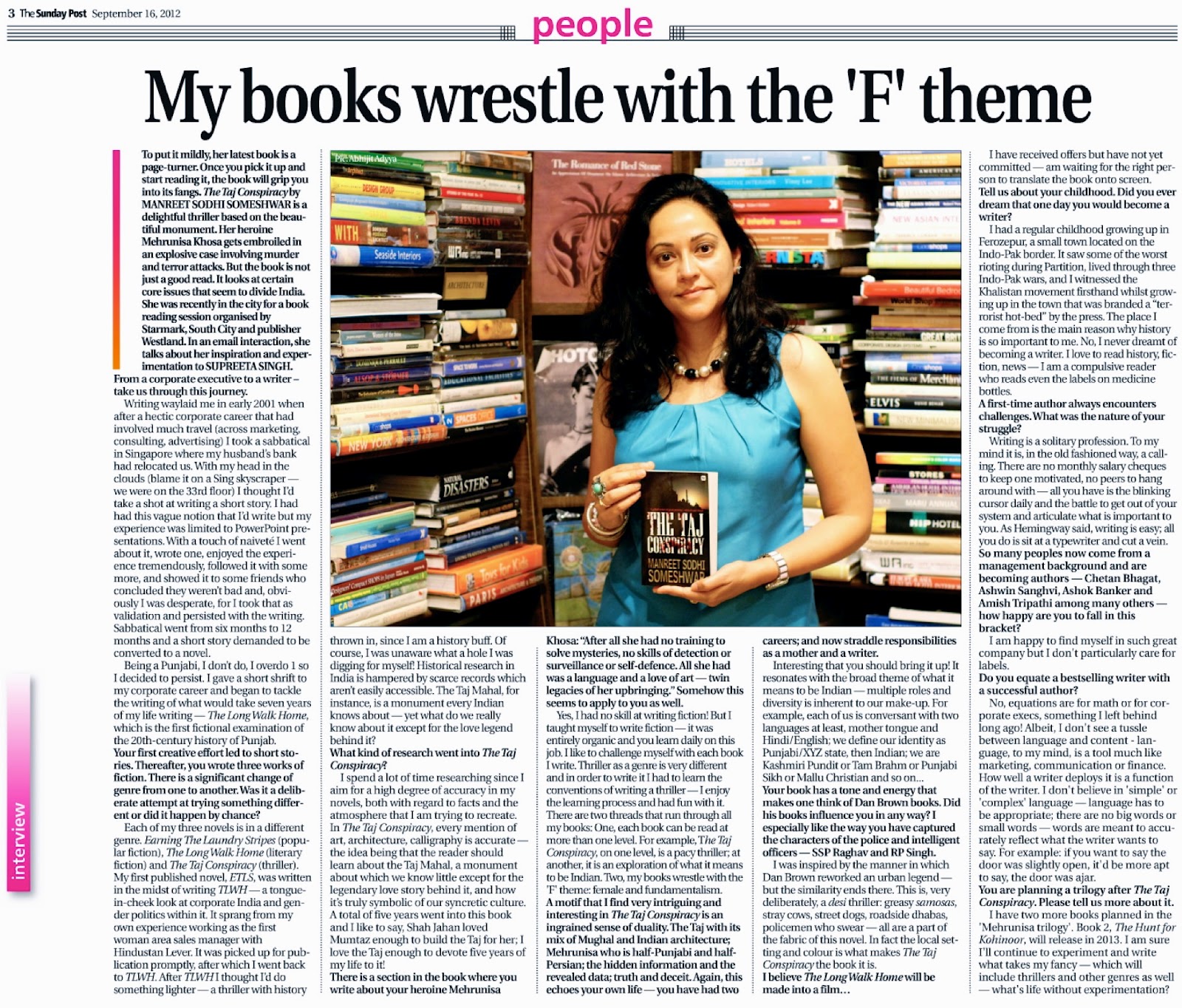
My Books Wrestle with the 'F' Theme


An in-depth interview with The Bengal Post on Writing, The Taj Conspiracy, Historical Fiction and What it Means to Be Indian!


Since the fine print might render reading difficult, below is a transcript of the interview.


1.       From a corporate executive to a writer – take us through this journey. Why did you decide to take a break? The shift should have prompted certain changes in your own life because being a writer is so different from being an author! How did you adapt yourself to this sudden change in career path?


Writing waylaid me in early 2001 when after a hectic corporate career 
that had involved much travel (across marketing, consulting, advertising) I took a sabbatical in Singapore where hubby’s bank had relocated us. With my head in the clouds (blame it on a Sing skyscraper – we were on the 33rd floor) I thought I’d take a shot at a
short story. I had had this vague notion that I’d write but my experience was limited to powerpoint presentations. With a touch of naivete I went about it, wrote one, enjoyed the experience tremendously, followed it with some more, and showed it to some friends who concluded they weren’t bad and, obviously, I was desperate
for I took that as validation and persisted with the writing. Sabbatical went from 6 months to 12 and a short story demanded to be converted to a novel. Being a Punjabi, I don’t do, I overdo – so I decided to persist, gave short shrift to my corporate career and began to tackle the writing of what would take 7 years of my life writing –
The Long Walk Home, which is the first fictional examination of the 20th-century history of Punjab.


2.       Your first creative effort led to short stories. Thereafter, you wrote three works of fiction. There is a significant change of genre from one to another. Was it a deliberate attempt at trying something different or did it happen by chance?

Each of my three novels is in a different genre: Earning The Laundry 
Stripes (popular fiction), The Long Walk Home (Literary fiction), The Taj Conspiracy (thriller). My first published novel, ETLS, was written in the midst of writing TLWH - a tongue-in-cheek look at corporate India and gender politics within it, it sprang from my own experience working as the first woman Area Sales Manager with Hindustan Lever. It was picked up for publication promptly, after which I went back to TLWH. After TLWH I thought I’d do something lighter – a thriller with history thrown in, since I am a history buff, seemed ideal. Of course, I was unaware what a hole I was digging for myself  Historical research in India is hampered by scarce records which then aren’t accessible easily. The Taj Mahal, for instance, is a monument every Indian knows about – yet what do we really know about it except for the love legend behind it?

3.       *The Taj Conspiracy* is steeped in history. What kind of research went into it? From conceptualising to execution to publication – how long did the process last?

I spend a lot of time researching since I aim for a high degree of accuracy in my novels, both with regard to facts and the atmosphere that I am trying to recreate. In The Taj Conspiracy, every mention of
art, architecture, calligraphy is accurate – the idea being that the reader should learn about the Taj Mahal, a monument about which we know little except for the legendary love story behind it, and how its truly symbolic of our syncretic culture.


A total of 5 years went into this book and I like to say. Shah Jahan loved Mumtaz enough to build the Taj for her; I love the Taj enough to devote 5 years of my life to it!


4.       There is a section in the book (page 125) where you write about your heroine Mehrunisa Khosa: “After all she had no training to solve mysteries, no skills of detection or surveillance or self-defence. All she had was a language and a love of art – twin legacies of her upbringing.” Somehow this seems to apply to you as well. Comment. Writing detective fiction requires a set of skills very different from writing novels in other genres. What went through your mind as a writer when you were writing a thriller? How did you equip yourself to face the challenge? And do you see a common thread that binds all your novels together?

Yes, I had no skill at writing fiction - indeed my experience was 
limited to powerpoint presentations! But I taught myself to write fiction - it was entirely organic and you learn daily on this job.

I like to challenege myself with each book I write. Thriller genre is very different and in order to write it I had to learn the conventions of writing a thriller - I enjoy the learning process and had fun with it.

There are 2 threads that run through all my books: One, each book can be read at more than one level. For eg: The Taj Conspiracy, on one level, is a pacy thriller; at another, it is an exploration of what it means to be Indian.
Two, my books wrestle with the 'F' theme: female and fundamentalism

5.       A motif that I find very intriguing and interesting in *The Taj Conspiracy* is an ingrained sense of duality. The Taj with its mix of Mughal and Indian architecture; Mehrunisa who is half-Punjabi and half-Persian; the hidden information and the revealed data; truth and deceit. Again, this echoes your own life – you have had two careers; and now straddle responsibilities as a mother and a writer. Please comment.

Interesting that you should bring it up! It resonates with the broad theme of what it means to be Indian - multiple roles and diversity is inherent to our make-up. For eg: each of us is conversant with 2 languages at least, mother tongue and Hindi/english; we define our identity as Punjabi/XYZ state, then Indian; we are Kashmiri Pundit or Tam Brahm or Punjabi Sikh or Mallu Christian and so on...


6.       Your book has a tone and energy that makes one think of Dan Brown books. Did his books influence you in any way? I especially like the way you have captured the characters of the police and intelligent officers – SSP Raghav and RP Singh. Most of the young readers in our country are fed on English books when it comes to thriller. Did it ever bother you that a local setting and context just might play spoil sport with the story?

I was inspired by the manner in which Dan Brown reworked an urban 
legend - but the similarity ends there. This is, very deliberately, a Desi thriller: greasy samosas, stray cows, street dogs, roadside dhanbas, policemen who swear - all are a part of the fabric of this novel. In fact the local setting and colur is what makes The Taj
Conspiracy the book it is.


7.       You are planning a trilogy after *The Taj Conspiracy*. Please tell us more about it. Would thriller be your genre now or would we see you moving onto something else?

I have two more books planned in the 'Mehrunisa trilogy'. Book 2, The Hunt for Kohinoor, will release in 2013. I am sure I'll continue to experiment and write what takes my fancy - which will include thrillers and other genres as well - what's life without experimentation?

8.       I believe The Long Walk Home will be made into a film? Please shed light on it.

I have received offers but have not yet committed - am waiting for the 
right person to translate the book onto screen.

9.       Tell us about your childhood. Did you ever dream that one day you would become a writer? What kind of books do you like to read?

I had a regular childhood growing up in Ferozepur, a small town 
located on the Indo-Pak border. It saw some of the worst rioting during Partition, lived through 3 Indo-Pak wars, and I witnessed the Khalistan movement firsthand whilst growing up in the town that was branded a “terrorist hot-bed” by the Press. The place I come from is the main reason why history is so important to me.

No, I never dreamt of becoming a writer. I love to read history, fiction, news - I am a compulsive reader who reads even the labels on medicine bottles.


10.   A first-time author always encounters challenges/obstacles. What was the nature of your struggle? Since you were already established in another career, and let’s say, that you shifted to writing later – do you think such a situation affected or influenced your struggle differently? What turns you on as a writer?

Writing is a solitary profession. To my mind it is, in the old 
fashioned way, a calling. There are no montly salary cheques to keep one motivated, no peers to hang around with - all you have is the blinking cursor daily and the battle to get out of your system and articulate what is important to you. As Hemingway said, writing is easy; all you do is sit at a typewriter and cut a vein.


11.   So many authors now come from a management background and are becoming authors – Chean Bhagat, Ashwin Sanghvi, Ashok Banker and Amish Tripathi among many others – how happy are you to fall in this bracket?

I am happy to find myself in such company but I don't 
particularly care for labels.


12.   Do you equate a bestselling writer with a successful author? I once had a conversation with Amish about the tussle between language and content – and the prudish assertion that bestselling books are not literary engagements – and how it effects one as an author. What are your observations on this?

NO, equations are for math or for corporate execs, something I left 
behind long ago! Albeit, I don't see a tussle between language and content - language, to my mind, is a tool much like marketing, communication or finance. How well a writer deploys it is a function of the writer. I don't believe in 'simple' or 'commplex' language - language has to be appropriate; there are no big words or small words - words are meant to accurately reflect what the writer wants to say. For eg: if you want to say the door was slightly open, it'd be more
apt to say, the door was ajar.

Saturday, 15 September 2012

Book Readings and All That Jazz: The Fun Behind the Scenes!

So, what goes on at a book reading? Is it all serious business? Do we have any fun at all? 

Well, well, well... I am letting the cat out of the bag with this video which gives a behind-the-scenes look at a typical book reading session. Enjoy!


If you had fun watching this, let me know! 

And yes, do 'Share' with friends & family - all good things are meant to :)

Monday, 3 September 2012

Upcoming Book Readings of The Taj Conspiracy in India

Hello friends!

We are bringing you some more book readings of The Taj Conspiracy in the coming fortnight. If you didn't catch us last time here's your chance to come say hello, join in the discussion and grab an author-signed copy of the book as well!

You'll find below the invites for the cities of Kolkata, Mumbai, Pune and Hyderabad - if you are in any of these cities, I look forward to meeting you :)

Kolkata

Mumbai

Pune Crossword

Pune Just Books

Hyderabad


Tuesday, 21 August 2012

Why I Wrote The Taj Conspiracy

I enjoy reading reviews on Flipkart - they are almost always unadulterated, and, therefore, good fun! My latest novel, The Taj Conspiracy, has been receiving its share of bouquets and brickbats, expectedly, and I am intrigued by what readers have to say: from 'India's Stieg Larrson' to 'The Indian Dan Brown' to 'Very ordinary' - we have got ourselves a range of reviews.

Additionally, there is one question I have been asked repeatedly: why did you choose to write about the Taj Mahal? Why not any other Indian monument?

Well, to know the answer, you'll have to hear a story. Ready?

It was a crisp winter morning in ‘08 when I last visited the Taj Mahal. As our guide urged us through the Jilaukhana, forecourt, I caught a fleeting glimpse of the white mausoleum perfectly framed in the arched entrance gateway. Before we could savour the moment, we’d stumbled through the gate into the lush gardens. 

The green of the chahar bagh contrasted with the red sandstone platform upon which stood the famed white mausoleum with its flanking buildings. Everything sang harmony - except our guide. Intent upon hustling us on, he ignored the perfect symmetry of the gardens, dismissed the central pool - almost as famous as the celebrities who pose from across it, gave a wide berth to the garden wall pavilions with their intriguing verandahs accentuated with coupled columns and arches ... 

No, for him, the Taj Mahal was only the white marble building at the north end, which, in turn, was some periodic table, materials and numericals interwoven, in which ‘marble’ and ‘sandstone’ popped with unsurprising periodicity. 

Admittedly, I was nonplussed. I am a writer, I like stories - they tell the truth, about the world, about ourselves, and since inception, homo sapiens have deployed stories to learn and remember by. 

x pheet by y pheet... marble... pheet pheet... sandstone... 

Why then was this guide bent upon dishing us an obscure periodic table? When I objected to the lack of a narrative, he nodded sanguinely and proceeded to a garnish of urban legends. I gaped.

Earlier that year, we had toured the Vatican museums with a guide who had brought alive the magic of Renaissance - Michelangelo’s marble Pieta had since found a home in my heart. Here was the world’s most beautiful marble monument that should be pulsing with life stories, yet its narrative was buried under bloodless piling of numerical detail and credulous myths when the true story of the monument was far bigger?

Did he know that the marble mausoleum at the north end of the complex descended in terraced steps towards the Yamuna as part of a riverfront terrace which was a Shahjahani innovation? That the emperor approached the Taj on a boat over the river as against the approach by tourists today - which is why we never sight the terrace rooms. 

How, while designing the Taj as Mumtaz’s home in paradise, Shah Jahan put all elements to work, even sound. The central domed chamber within the mausoleum has such perfect acoustics that it is renowned for one of the longest echoes of any building in the world.

That an Englishman’s love has illuminated the imperial Mughal tomb for over a century. The bronze lamp that hangs over the cenotaphs was especially gifted by Lord Curzon who, dismayed by the smoky lanterns the guides used to show him around, resolved to present the Taj with worthy lighting.

That the Taj Mahal, Islamic in conception yet imbued with Hindu elements, is a syncretic creation truly symbolic of our culture.

When we departed, I turned once to look at the Taj. This time, unhindered by the guide, I savoured it framed within the arched Darwaza-i-Rauza, the mist swirling around its marble dome. Somehow, the Taj looked forlorn, as if it needed someone to tell its story...

The guide had come highly recommended; apparently his clientele included foreign corporate clients. Imagine what havoc the less recommended guides must yield? 

I resolved that day to write a novel around the Taj Mahal, one that would rescue it from ignorant guides and benighted rumours and show it for what it really is - as the colour white contains all colours within it, this monument of white comprises multiple, diverse threads of a pluralistic India. 

Thus was The Taj Conspiracy born.


If  you get to read the book, I'll be happy to hear your thoughts. So, write in!


Friday, 3 August 2012

TV 9 Coverage of The Taj Conspiracy

They got my name wrong - ah, again! - but got the coverage right! The short clip gives a peek at the book launch and has a brief interview with yours truly :)


During the Benagluru launch of my third book, The Taj Conspiracy on 13June 2012

Tuesday, 17 July 2012

Meeting the Man with Malice Towards One and All

Admittedly, there isn't any Indian over the age of ten who doesn't know Khushwant Singh; know him in one of his various avatars: the Sardar in the lightbulb, the writer behind the slim seminal defining work on Partition, the editor behind Illustrated Weekly, the columnist whose trenchant wit was evident weekly, the self-anointed dirty old man of journalism... 

Similarly, I have known him since the age of seven or eight when my father started passing on the newspaper to me with the instruction that I read his column, it would improve my English. Same with the Illustrated Weekly of India - that cheeky, salty newsmagazine with its defining cartoons that was helmed by Khushwant Singh for several years - the reading of which was prescribed to hone English language skills. Over the years I was to discover his other avatars... 

I came late to 'Train to Pakistan' - the historical novel published in 1956 which tells the monumental story of India's division through the lives of residents of Mano Majra, a village located on the border between India and Pakistan - during a career sabbatical in early 2001. It taught me more about the partition of the subcontinent than my cumulative history lessons. Serendipitiously, I had just started to write , and having grown up in a border town which was labelled a "militant hot bed" by the media during the Khalistan movement, at that time was struggling with a story around the Khalistan movement. Suffice to say that Mr Singh's novel unlocked my creative juices and pointed me in a direction which was to take me seven years before the first fictional examination of the 20th century history of Punjab, The Long Walk Home, was published.

The narrative arc of The Long Walk Home starts pre-Partition and comes all the way to the present. The research took me deep into an understanding of the Sikh faith, its origin and growth, where his 'A History of the Sikhs' was my veritable Bible. 

Upon the book's publication in July 2009, I was very keen to meet with Khushwant Singh and my editor tried to arrange a meeting. However, during the Delhi launch Mr Singh was off to Simla for his summer retreat. I rued that missed opportunity to meet the man who had strongly influenced my writing. Imagine my surprise, therefore, when a week later, he reviewed the book in his weekly column and gave his nod of approval! I remember telling my husband that after Mr Singh's review, none other really mattered.

Come 2012 and my third novel, The Taj Conspiracy, was released in June. The book's cover carries a blurb from Khushwant Singh: a gifted writer of great promise. The Delhi launch was scheduled for 7 June. Once again, I was seeking an opportunity to connect with him, if possible, for Mr Singh, at 98 years, has practically retired from public life though he continues to write daily and his weekly column is syndicated across several Indian newspapers.


My Publisher was trying to arrange a meeting and I was checking my inbox till the moment the flight took off, but no luck. In Delhi the next morning as I checked my mail I discovered I was finally getting lucky. Apparently, a very resourceful person at my Publisher's had sent across to Mr Singh copies of The Long Walk Home and The Taj Conspiracy along with a print -out of his review of the former and he had granted me a half hour window, 4-4.30 pm.

The day passed in some kind of surreal haze as I met retailers and booksellers before heading to Sujan Singh Park, the residential complex built by Khushwant Singh's father, where he lives. As I entered his living area, a high-ceilinged cavernous room lined with books, I sighted him in one corner, grey and hoary in his armchair from which he watched us approach.

As I wished him Sat Sri Akal, the traditional Sikh greeting, and introduced myself, he replied, "Tusee Guru-ans hoye" - Guru-ans are descendants of the Sikh Gurus and my father's family traces their lineage back to the 3rd Sikh Guru. 

Thereafter, we conversed for a half hour, in a mix of Punjabi and English, and few conversations before this have packed so much in such little time. We discussed Ghalib, jointly recited Bulleh Shah, chatted about the '62 Indo-China war, Hong Kong people and HK cuisine, family, memory, Sikh Gurus, sohni kudis and old men! 


When it was time to take leave I requested him to sign my copy of The Taj Conspiracy. Sign it he did, with the Sikh blessing: charhadi kala vich raho. Have a buoyant spirit! 

Sir, if I have an ounce of your erudition, wisdom or wit when I am 98, I'd have lived well. Besides all that we talked, the grace notes of that mellow afternoon in your study will always stay with me. To THE Sardar! 


Friday, 22 June 2012

Two Fantastic Promotions on The Taj Conspiracy

Hello friends! The Taj Conspiracy is inching up the Top 10 Bestseller list: up from #4 to #3 in Week 2 of launch! Thank you for your support :)

If you haven't grabbed your copy yet, we have two fantastic promotions for you:

1. Buy The Taj Conspiracy at Flipkart and get a free booklet of Book 2 in the Mehrunisa trilogy, The Hunt for Kohinoor


2. Check the Facebook page of my Publisher Westland Books, 'Like' us, and get a whopping fan-only 43% discount on The Taj Conspiracy!


So, what you waiting for?!

Monday, 18 June 2012

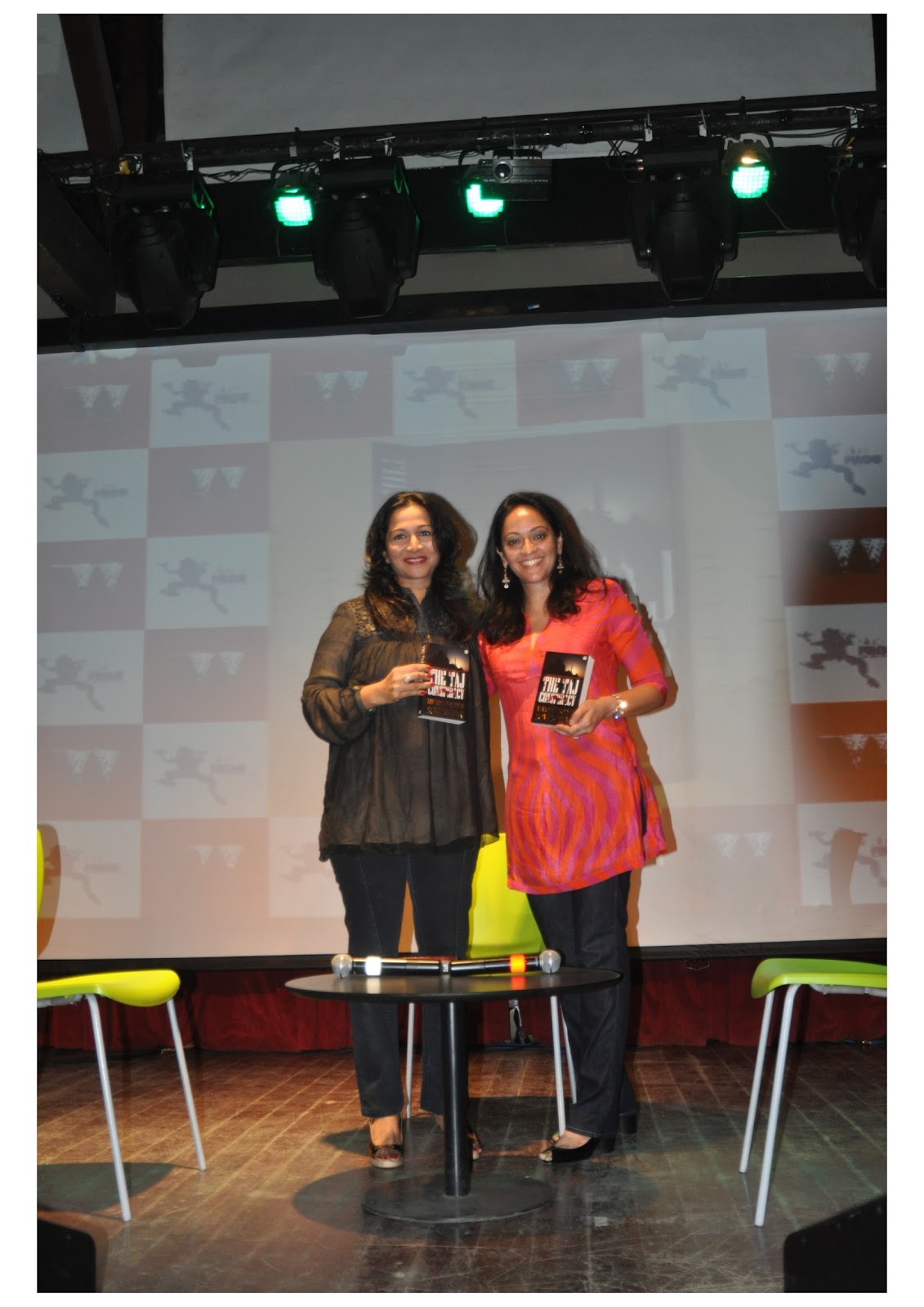
Pictures from Launch of The Taj Conspiracy & Interview with Kiran Manral

During the Mumbai launch of The Taj Conspiracy, I was in conversation with Kiran Manral, popular blogger and author of The Reluctant Detective. Subsequently, Kiran did an interview with me which she has posted on her blog. In case you'd like to read it, here's the link.

And sharing some pics from the launch :)


At the Delhi launch at Blue Frog 7 June 2012


Noted film maker Muzaffar Ali launched The Taj Conspiracy 

Muzaffar Ali following the discussion, a copy of The Taj Conspiracy tucked in his hand

At the Mumbai launch, Blue Frog 9 June 2012

In conversation with Kiran Manral

Bengaluru launch at The Park 13 June 2012

Mr Praveen Sood, Senior IPS Officer released the book in Bengaluru


Thursday, 14 June 2012

Hitting the Bestseller List


Friends, I am busy promoting my third book, The Taj Conspiracy, and in India on a book tour. My publisher sent me this image and I thought to share my happiness with all of you :) Hope you get to read the book soon too!

The Taj Conspiracy hits the bestseller list in the first week of launch :)


Tuesday, 5 June 2012

Catch Me If You Can!


Calling all Mumbaikars! Am told travel by BEST is still best :)


For those of you coming fresh to this blog, here's a brief synopsis of the book which is merrily displayed on a BEST bus's bum!

  Book Summary of The Taj Conspiracy

Mughal scholar Mehrunisa Khosa stumbles on a conspiracy to destroy the Taj Mahal when she discovers the murder of the Taj supervisor, and the Quranic calligraph on the tomb of Queen Mumtaz altered to suggest a Hindu origin of the Taj Mahal. That urban legend had always existed. Now, though, someone was conspiring to make it come true.

In the case of the famed marble monument, all was not on the surface. A vast labyrinth ran underneath closed to visitors where Mehrunisa was trapped once. In a series of suspenseful twists and turns, the action traverses from the serene splendour of Taj Mahal to the virulent warrens of Taj Ganj, from intrigue laden corridors of Delhi to snowy Himalayan hideouts.

As a right wing Hindu party ratchets up its communal agenda and Islamic militants plot a terror attack, in the dark corners of his devious mind a behrupiya, a shape shifter, is conniving to divide the nation in two. To save the Taj Mahal, Mehrunisa must overcome a prejudiced police and battle her inner demons as she sifts the multiple strands that lead to the conspirator.