Praise for My Books


"Manreet Sodhi Someshwar is a gifted writer of great promise. I have a gut feeling we have a new star rising in Punjab's literary horizon. She has an excellent command of English and a sly sense of humour."
- Khushwant Singh on The Long Walk Home

"An enjoyable tale of a sassy girl's headlong race up the corporate ladder."
- India Today on Earning the Laundry Stripes


Showing posts with label Charles Dickens. Show all posts

Wednesday, 8 February 2012

Please, Sir, Thoda Adjust Karo Grave Sey, Yeh Dil Maange More!


When I am asked who my literary influences are I name a triumvirate: Mirza Ghalib, Shakespeare and Charles Dickens. However, it would be more accurate to say that they are my earliest influencers and had the most impact for they impinged upon me in early childhood. Thereafter, I’ve admired and greatly enjoyed several writers but it would be fair to say that I haven’t been able to “shake off the pear and close the dikkan” - as a character in my second novel, The Long Walk Home, says.

Shakespeare and Dickens were part of the English curriculum at our school (a convent run by Keralite nuns) and my eldest sister - ahead by five classes - was riffling through Julius Caesar and Great Expectations when I was lost in a world of numerically named detective clubs - Secret Seven, Famous Five, Five Find-Outers - who had an awesome dog, collated clues over scones with marmalade, and solved mysteries.

 At some point, when Enid Blyton gave me breathing space and my sister felt like reading aloud, the Bard and Charles also impinged upon my consciousness. So I made acquaintance with Philip Pirrip who could only call himself Pip, with young Estella who had no heart, with Miss Havisham who resided with her rotting wedding cake in a ruined mansion, with the escaped convict in shackles who wants to eat Pip’s fat cheeks! 

Oooh! I listened, with terror in my heart and begged my sister to not stop. Of course she did but she continued to indulge me with several readathon sessions where she felt that reading aloud would help her memorize the soliloquy that was a surefire Board exam question or the paragraphs which lent themselves exquisitely to the examiners’ ‘Reference to the Context’ questions. 

So I listened, chronology or context be damned, for the words had me in their fevered grip as Mark Antony exhorted his “Friends, Romans, countrymen”, Miss Havisham trawled Satis House in her wedding dress, a shocked Caesar said "Et tu, Brute?" and fell to his death, Uncle Pumblechook breathed like a fish, a soothsayer warned to “Beware the ides of March!”, Estella married Drummle and broke Pip’s heart, and “it was one of those March days when the sun shines hot and the wind blows cold; when it is summer in the light, and winter in the shade” ...

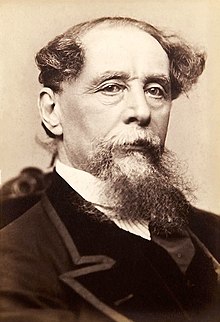
It kindled a love - for words, books, characters, and compelled me - at a point in my corporate career when I was jaded - to resume a love affair of my own making. A vocation and passion for which I have to thank, in part, the Victorian novelist with wise eyes, balding pate and scraggly beard who wrote the most terrific tomes to ensnare a ten-year-old.

On 7 February 2012, Charles Dickens’ 200th birthday celebrations have been galore. Google’s doodle featured some of Dickens most popular characters including Scrooge and Pip; Prince Charles led the celebrations in UK; and bells rang out over London as fans gathered to mark his bicentennial.

And rightly so! Dickens is hailed as the father of the novel and the magic of his words stays strong. If you haven’t read him, for whatever inexcusable reason you might profess, may I suggest your initiation with either of Great Expectations or A Tale of Two Cities? You’re lucky, you know!

As for me, on his 200th birthday, what I wish to say to Charles Dickens really is, “Please, sir, I want some more” - my need is as great as Oliver's. Perhaps some jugaad in good ole Desi fashion might yield results: Please sir, thoda adjust karo grave sey, yeh dil maange more!


Wednesday, 2 November 2011

Writers Who Reveal


A friend sent me a link – Should writers be sexier than you? – and asked what I thought. Thought? This was no time to think, girl!

What I had to do was look up the hottest fashion photographer in HK, throw a saree on me like I was a gori who had no idea where the pallu was supposed to stay (on the shoulder, covering both the boobs if you please – I know the likes of Priyanka Chopra have made a single boob show in but hey, I ain’t a Bollywood actress, and I still need to dress in a manner that sends the right signals to my daughter), or imitate the writers in the article who looked like they were in the race to be the current dhak-dhak girl. Having accomplished that hot pic, I’d declare myself a sexy novelist, then sit back and watch my soaring sales that'd have Beyonce herself googling her new competitor.

Think I am bullshitting – read up on The Hot Authors project that, aghast at the prospect that writers are losing their place as cultural heroes, suggests they should start competing with pop culture stars on the same level. “Let’s promote novelists as sexy and fabulous. Insist that PEN award require a turn on the catwalk! Hold the National Book Awards on a sliver of sand populated by buxom models in horn-rimmed shades …” 

Compete with pop culture? Heavens, what do they have in mind? Lady Gaga or Kim Kardashian?

So, it seems that now, as a writer, I have to preoccupy myself with foundation (other than that of storytelling), depth (of cleavage, not character), plot (not narrative but moves that shall get me on the ‘Hot Authors’ list), details (not those that flesh out my characters but of what constitutes ‘Hot’) and other such infernal notions that are meant to plague the world of pop artists, Bolly-Holly stars and reality TV divas.

Uh-hmmm… The fact that artists reflect the prevailing culture seems to have escaped their festering brains altogether. We live in a digital, 24x7, consumerist world, inundated with choices, where our attention spans are under perennial assault. An average book takes longer to consume than a pop song or a reality show. And looks have always had a premium in our culture but looks have nothing to do with what the artist creates. Rafael was decidedly the handsomer Renaissance artist but both Michelangelo and he created art that is feted to this day. 

A writer, primped out in an LBD or a wet saree or 3-buttons open (what is the advice for male writers here? Oh yes, the Hot Authors Project shot a writer in his undies in a tub!) shall as quickly become a pop culture star as the average kid grows up to be Superman because he donned the costume with the red knickers. 


Writing is not performance art. A writer’s work – book, poem, essay, blog, news report – is written in a solitary space and meant to be consumed by an individual. The product, in that sense, is truly one-on-one, a conversation the writer begins and the reader completes. The catwalk, the sandy beach strewn with buxom ladies, are all evoked in the mind by that black ink on white (or sepia as ipad allows). As are conjured blind assassins and blood meridians and midnight’s children and the wide Sargasso sea – the creation of which didn’t need for their writers to be good looking or sexy or hot. All they required of them was that they hunker down and tussle with their craft and not give up until they had produced the best work they could.  

As Kafka said, a book must be the axe for the frozen sea within us. Writers reveal with  their souls.

Writing, I have always maintained, is like any other work, except you love what you do! But there is a price to be paid for that love: no monthly pay cheque, no gossip with colleagues at the water fountain or in the pantry, no external enforcer of discipline, no business-class airfare when traveling on work, no annual bonus to validate one’s self-worth.

But, we’ll live with the shortcomings. Just don’t bullshit us that how we look/dress/catwalk is more important than what we produce – our writing.

I learnt in B-school that bullet points are a great way to get the message across, even to dumb initiators of Hot Authors Project. So here:
  • Hot/sexy is in the eyes of the beholder
  • The playing field for a writer is not a catwalk, it is the 5-inch space between the ears
  • Writing is not performance art
  • In an age of consumerism, no writer, when they have to step out – whether for a litfest, or photo shoot, or book reading, or speaking engagement – fails to step up. All writers are keenly aware of the pressure to market themselves (the Publisher would shoot them otherwise). And on that note, most author photos are photoshopped fraud!
  • If that isn’t enough, imagine the writers you’d never have read because they weren’t hot enough: Dickens, Shakespeare, Ghalib, Iris Murdoch, Nabokov, Vonnegut, Doris Lessing… 

If you are a writer, my advice: write the best book you can, and then market like crazy! 

Monday, 25 July 2011

A Rare Achievement or Hot Air: Can One Book Be Both?

Hot air beneath a layer of subcutaneous fat ... resurrects a Mumbai staple ... parcelling it in comically fustian prose

A funny yet deeply melancholic work ... is brilliant, and remarkably mature ...  A rare achievement

The preceding two statements come from two separate reviews of the same book published recently. The book is written by an Indian (?), or, at least, a writer of Indian origin, revolves around an Indian city - Mumbai, and the two reviews come from two magazines - one Indian, the other not. (No prizes here for guessing which comes from which.)

I am not picking the statements out of context - the first is the lead into the review, the second the finale, and the complete reviews can be read in the links provided. What I am looking to do is to explore how one piece of writing can be viewed so differently by two very credible reviewers.

Writing is supposed to be universal - in which case, why such polarity?

The skeletal underpinning of all writing is alike, it is the dermis and the clothes the writer adds that provide the specific details that furnish us with a context. The dilemma, and consequent sacrifice, of Sydney Carton in A Tale of Two Cities is instantly recognizable; the character who will sacrifice his life to preserve the lover of his beloved, the louche who hides within him the heart of gold has been seen in films and books before. And yet, Dickens' Sydney is unmistakably Dickens' Sydney: the British barrister who is bloody brilliant yet self-indulgent and self-deprecatory and whose redemption must lie in his own effacement - the ultimate tribute to the very English trait of stiff upper lip!

Must we then examine the process by which books are reviewed? Which begets the question: what is the purpose of a review?

A review is an evaluation; it is meant to provide its readers with a synopsis and critical analysis of the material at hand - be it book, movie, play - and leave the reader with a clear viewpoint of the reviewer and, therefore, his recommendation to go for it or ditch it.

But a review is also personal and subjective since a reviewer brings to the material his own perceptual filters. In fact, the best reviewers are highly opinionated - Roger Ebert, Michiko Kakutani - choosing to provoke, educate and entertain through forthright distillation.

And yet, there isn't any denying that reviews can be, and often are, compromised because of associations with publishers, writers and their agents. Or, in today's world especially, the marketing hype accompanying a new book can overwhelm a reviewer and cower into adhering to the trumpeted line. Just think of the last anticipated arrival on the book racks that was not heralded as brilliant, coruscating, masterly, compelling ... yawn ...

And then, there are times when the reviewer is plain lazy or has a deadline to meet. In come the Seven Deadly Stuffers - duds that are packed in with regularity to bolster a review.

Enough of reviewers, what about the writer? Is the book intended for a particular audience? Did the writer have some target group in mind?

Indian publishing is newly flush with writers who claim they aren't writing for a gora audience. Instead they are telling Desi stories intended for their country folk who are lapping them up. And the sales of such books support their claim, be it Chetan Bhagat or Amish Tripathi or Rashmi Bansal.

The flip side of the coin then is that writers such as Seth and Rushdie and Desai were writing for a western audience who are interested in the 'exotic' image of India, that of mangoes and hennaed hands and squalor. I don't agree with that view but the cover designs of fiction by Indian writers sold abroad tend to favour the 'exotic' look. And despite the saying, a book is judged by its cover. Hmm... biases, biases, biases ...

Which brings me back to where I started. By now, you'd have followed the links, read the reviews and figured that the book in question is Last Man in Tower, Aravind Adiga's second novel after his Booker win. My dilemma: should I read it? I wrote the post to sift through the conflicting arguments in my own head but am I any clearer? Dunno.

How we engage with a book is a function of who we are, which, in turn, is a function of the books we have read, the environment we've grown up in, etcetera. Adiga's first novel The White Tiger left me scratching my head at the collective wisdom of the Booker jury. Awarding the prize in 2008, Michael Portillo, the chair of the judges, said in praise of the book: "Does this book knock my socks off? And this did."


I have to admit though, Mr. Portillo, that I had to peel my socks off - blame Hong Kong's humidity. And in my subsequent review for the SCMP I said:

In the seventies a pair of Bollywood scriptwriters, drawing on the chaos of the times, created the character of an “angry young man”: a man raging against the avarice of an elitist system in which many are sacrificed to the whims of a few. The reputation of Amitabh Bachchan, the legendary Hindi film star, rests on his myriad portrayals of just such a defiant character. Thirty years hence, transported into the newly-chaotic India of a booming economy and rising economic divide, Balram Halwai is alas a feeble Xerox of the angry young man.

The White Tiger was described as a bracingly modern novel about the dark side of new India. Nonetheless, for any one looking to read about contemporary India's fetid underbelly, I'd recommend The Story of My Assassins by Tarun Tejpal.

Ultimately, what a book means to us has to do with whether it resonates with us. Does its narration strike a chord within, do the characters find a home in our soul, do their tears and laughter echo in our own lives? That, to my mind, is the test of any book.

Recently, Rupert Murdoch was attacked at a Parliament hearing by a pie thrower. Before the attack the man had tweeted: It is a far better thing I do now than I have ever done before.

He was harking to a quote from Sydney Carton in A Tale of Two Cities when he goes to his death voicing, "It is a far, far better thing that I do, than I have ever done; it is a far, far better rest that I go to than I have ever known".

Not for no reason does Dickens' novel published 150 years back still find resonance with people!

To round up this post, if any of you have read Last Man in Tower, please share your views with me. My promise: an open mind; My hope: for some resonance.