Praise for My Books


"Manreet Sodhi Someshwar is a gifted writer of great promise. I have a gut feeling we have a new star rising in Punjab's literary horizon. She has an excellent command of English and a sly sense of humour."
- Khushwant Singh on The Long Walk Home

"An enjoyable tale of a sassy girl's headlong race up the corporate ladder."
- India Today on Earning the Laundry Stripes


Showing posts with label book review. Show all posts

Tuesday, 24 September 2013

Book Review: Questions of Travel by Michelle de Kretser

This review first appeared in the Asian Review of Books on 22 September 2013


Questions of Travel opens with an intriguing line, “When Laura was two, the twins decided to kill her”, and pulls you in. Why was the child thus marked, and did she survive? 

Laura Fraser’s mother succumbed to breast cancer soon after she was born, linking her thus in her twin brothers’ minds to her demise. They hatch a plan to kill her through accidental drowning by making sure to open the safety catch on the swimming pool gate. But Laura survives the splash to be brought up in the care of elderly aunt Hester who “had spent the first seven years of her life in India, from which misfortune her complexion, lightly polished beech, never recovered”.

Nevertheless, Hester has been places, as evinced by her sky-blue travel case, the repository of souvenirs from her travels in the Continent. And she is happy to regale Laura with elaborate stories from each of those trips, recalling in magnificent detail all that was beautiful, while glossing over inconveniences such as “the unspeakable filth of Greek public lavatories”.  No surprise then that Laura is hooked to the idea of travel from an early age.

Questions of Travel is Michelle de Kretser’s fourth novel, following the much-acclaimed The Lost Dog that was longlisted for the Booker in 2008. As the title suggests, this book is an exploration of travel, what it means in an increasingly connected world, what it throws up in its wake and what it reveals to us of our own selves in the process. 

The narrative begins in 1960s and traverses to 2004, covering almost half a century of travel and concomitant reflection. It is told from the points of view of two people, the white Australian Laura Fraser and the Sinhalese Sri Lankan Ravi Mendes, in alternating chapters. While Laura is keen to leave her tidy Ozzie perch, spread her wings and discover the world, Ravi’s country is increasingly wrecked by sectarian conflict and a contingent of fleeing emigrants. 

There is a stark contrast between the two stories: Laura leads a hippieish existence where everything is up for grabs while Ravi’s life is rooted in his family and birth place but increasingly imperiled by ethnic strife. De Kretser is a wordsmith, stringing her words such that they throw up vivid images, bring a quiet smile frequently to the lips and deliver many Ah-ha! moments. The narrative is constructed in short chapters with short sentences which give an instagrammatic feel to the text, a here-and-now telling of life through images, an online photo-sharing rendered via text. The effect is both magical and disconcerting; you want to sink your teeth into the story but you are distracted by some riveting imagery, and then, some more. 

Perhaps this construct is an ingenious storytelling technique for a novel about travel, a series of linked snapshots. However, it has the effect of distancing the characters – we are very aware of watching a story unfold and never become one with the characters until midway through the story when boom! a terrible murder tosses Ravi straight into the mayhem of Sri Lankan ethnic politics. 

Ravi is an easier character to empathize with. Defined by his relationships – with his mother, sisters, wife, son, his efforts to comprehend the terrible twin tragedy life has thrown at him are etched with verisimilitude. Ravi gets a much sought after opportunity to seek asylum in Australia – will he able to start life anew in a fresh land unburdened by the horrors of his past? Will the travel of a thousand miles help shed the baggage of loss and free him from fear?

Laura, meanwhile, comes across as a stereotypical hippie who gets to know a new place by sampling its cuisine, its sights and its men. (In contrast, when Ravi lands in Australia, he familiarizes himself with the place by walking for hours.) Her rather voracious appetite for each of these lands her a job with a travel guide, thus completing the virtuous circle. Laura’s life is the more instagrammatic of the two protagonists, the images supplanting the emotional heft of this story. To this reader at least Laura, despite her witty observations and keen eye, remained a bit of a cipher. 

Questions of Travel is a strange beast, a bit of a chimera – it is packed with engaging anecdotes, glimmers with insight and wit, yet it disorients with its rapidly shifting tracks and leaves one slightly cold. Travel, especially in today’s global world, has questions and implications for each one of us. What is foreign or new when we have already consumed it before in countless images? Will the first sight of Eiffel Tower leave a new traveler slightly underwhelmed because the glossy images promised more? What is home when travel allows us to pack our bags and seek a new one wherever we may desire?

De Kretser tackles some of these questions in this baggy yet light novel – I wish she had wrestled with more might. Ultimately, Ravi Mendes decides he doesn’t want to naturalize and returns to his native Sri Lanka. Laura, meanwhile, wings her way back to Australia, timing her return with care. “Six months later, what still struck Laura were the hats, the babies in sunglasses, the Factor 30 sunscreen, the little kids on the beach in neck-to-knee cossies… The planet’s ills came home in six words: Australians were afraid of the sun.” Does travel then hold up a mirror to us? 


With Ravi and Laura both returning to their native countries after their peregrinations, perhaps the writer is suggesting that the purpose of travel is to help us reassess and re-love our own homes. 

Tuesday, 13 August 2013

Book Review: The Hope Factory by Lavanya Sankaran

This review first appeared in the Asian Review of Books on 12 August 2013


The Hope Factory is Lavanya Sankaran’s debut novel after her acclaimed short-story collection, The Red Carpet. The novel is set in Bengaluru, erstwhile Bangalore, better known to the outside world as India’s Silicon Valley. The city is home to Infosys, India’s pioneering software company, and a growing multitude of corporations that provide outsourcing services, telemarketing, business consulting and software engineering. It has been at the forefront of India’s economic development—concrete buildings supplanting fields, multistory residential complexes elbowing out leafy bungalows—besieged by lagging infrastructure and widening income inequality. Such a city is rife with stories.

The novel begins with Anand in his office at Cauvery Auto, a company he has assiduously built over the years, nervously anticipating the arrival of his largest customers. They are to bring with them representatives of the Japanese parent company on a factory tour. If all went well, Cauvery Auto could end up supplying the international market, a welcome prospect as Anand is looking to grow his business. Acquiring land for industrial development was increasingly difficult in the city but Anand is hopeful of organizing something. 

At home, his whimsical wife Vidya rules with the help of three domestic helpers, one of which is Kamala. Maneuvering between the shenanigans of the cook Shanta and the other helper Thangam, Kamala must accomplish her chores without upsetting Vidya-ma, swallow the occasional scolding and strive to provide for her son Narayan and keep him off the streets and in school.

The Hope Factory tells its story in two voices through alternating chapters. One voice is that of Kamala, the domestic worker and single mother, struggling to make ends meet on her meager salary. The other is the voice of Anand, industrious entrepreneur, dedicated father and flustered spouse looking to maintain marital harmony in the face of an overly obtrusive father-in-law and a wife whose whims match the volatility of teen fashion. 

While Kamala and Anand are separated by many markers—social and economic—they are also strivers, both hopeful that their individual endeavours will pay off with a more prosperous future. Anand’s hopes are tied literally in his plans for the new factory while Kamala is vested in providing her son with higher education, a factor that will lift him out of their penury.

Sankaran is a competent writer moving fluidly between the urbane Anand and the anxious Kamala. Not that Anand does not have his anxieties. He has risen from a humble background, his wife is increasingly distant from him, his father-in-law is a social bully content to flaunt his “connections” in Anand’s face, the landbroker appears shifty and Anand spends restless nights wondering if he’ll be able to procure the land he needs to expand his factory without which Cauvery Auto’s overseas venture will be aborted.

Adding to Anand’s travails is the arrival on the scene of Kavika, an old female schoolmate and friend. Kavika has returned home after a long foreign stint, with a child, no discernible husband, and allusions to a mysterious past. With her cropped hair and easy manner, Kavika is a counterpoint to Vidya, a fact that Anand seems to appreciate and mask. 

Anand’s demeanour around Kavika harks to an adolescent crush that he never outgrew. Moreover, Kavika shows much enthusiasm for Anand’s venture compared with the lackadaisical response of his wife; will the mutual interest develop into something more? Matters get complicated when Vidya appears just as smitten by Kavika, opting to cut off her hair and favouring the handicraft clothes that Kavika wears. The growing friendship between the women throws Anand into Kavika’s presence frequently, something he anticipates with a guilty pleasure. The triangle as a narrative hook unspools slowly.

Meanwhile, Kamala has been advised that if her son is to succeed he must study in a private school, the government run school being a dud. Her big worry is that she cannot afford her son’s education in a private school even as the shack she rents appears ready to be seized for property re-development. But Kamala is a plucky woman who knows how to seize the bull by its horns. Years ago, when thrown out of her house after her husband’s death, she managed to leave her village, fend her way to a big city like Bengaluru and find employment—all with an infant suckling at her breast. She decides to approach Anand-saar for a solution to Narayan’s education.

The Hope Factory proceeds at a leisurely pace for a major part of the novel, Sankaran focusing her eye on the minutiae that bring the narrative alive: the quibbles of the household staff, the zeal of Anand’s employees, the flipflops of the real estate broker, the frequent whims of Vidya, the loving interaction between Anand and his two children. The storytelling evokes R. K. Narayan, the Indian writer who chronicled the intricacies of ordinary Indian lives with a sharply observant yet compassionate gaze.

However, the last one-third of the narrative cranks up as the land deal Anand is pursuing gets embroiled in the quagmire of politics, and the crisis at Kamala’s landlord’s heightens. Anand has won the order from the Japanese but he is yet to acquire the requisite land. In what seems like a departure from the methodical, precise man he has been presented as Anand indulges in chicanery of the kind that would put his flamboyant father-in-law to shame, and saves the day for his factory, his workers, even Kamala.

Sankaran’s prose is richly satisfying, her characters fully fleshed, yet I wonder how much of their struggle will stay with me. One question this reviewer couldn’t help asking was what would have happened if the messy tangle of land-politics-people had unspooled further, the writer forsaking succumbing to a tidy resolution?


The kernel of the novel is an erstwhile sleepy town scrambling for metropolis status, engendering a messy sprawl in its wake—rather than a gasp of recognition at the mirror held to view, it evokes deja vu. A pity, as there is much to admire in the book, just nothing new.


Wednesday, 5 June 2013

Book Review: And The Mountains Echoed by Khaled Hosseini

What does an Afghan owe to the country that he left to escape violence? Should Afghan-Americans feel guilty over their material possessions, one of which could fund a child’s hospitalisation expense in Afghanistan today? Can a person ever truly cut off his roots or will they reach out in time and space and draw him back like a homing pigeon to its dovecote? 

-- My review of 'And the Mountains Echoed' that appeared in the SCMP, 2 June 2013


If you can't read off the image, click link 

Friday, 3 May 2013

Book Review: Sita's Ascent by Vayu Naidu

This review first appeared in the Asian Review of Books on 24 April 2013


The epics have stayed alive in India through a vigorous tradition of oral telling. This tradition has also cast the Ramayana into several avatars, the story being reinterpreted by region, language, caste in South and Southeast Asia. R. K. Ramanujan, a renowned scholar of Indian literature, in his essay titled “300 Ramayanas”, recounts myriad retellings of the epic, many of which contrast with the Valmiki Ramayana that most Indians are familiar with. In a South Indian folk account it was Ravana, the King of Lanka and Rama’s antagonist, who births Sita through a sneeze. The Thai version gives centre stage to Hanuman, the monkey King—Hanuman being considered a more colorful and empathetic character than Rama.

What is common to the retellings is that they are coloured by the homilies and virtues of the particular community within which they have evolved. For instance, the Jain telling of the Ramayana present Rama as a Jain who doesn’t slay his enemy since it is against Jainism to take life. In a Tamil version of the epic Sita is the warrior who goes to battle against Ravana.

Sita’s Ascent is a novella by Vayu Naidu who runs a namesake storytelling company out of London. This debut is a revisiting of Sita, the heroine of the Hindu epic Ramayana and the wife of its hero, Rama.

Vayu Naidu’s retelling is an attempt at “a reimagining of the idea of woman as goddess” by weaving the narrative through the point of view of multiple characters in the epic who were close to Sita. Dr Naidu, who has researched Indian oral traditions, was fascinated by “the inspiration that is Sita—an exiled queen, an expectant mother abandoned and left alone, undaunted by the extraordinary circumstances that are thrust upon her by the husband she continues to love”.

Sita is the dominant female role model that Indian girls are brought up on. Her values of unyielding loyalty, steadfast devotion and unconditional love despite hardships hurled at her by a patriarchal system are seen as ideal attributes for the Indian woman.

The Sita in this novella is a fully realized character, a woman who speaks her mind, who is confident of her inherent female strengths. Yet she doesn’t break the mould of Valmiki’s Ramayana, content to raise her sons in a hermitage until they are ready to face their father, King Rama.

Some other characters, though, are explored afresh. Lakshmana, Rama’s younger brother who accompanied him in exile, is vulnerable as he reminisces his causal role in the ultimate war. Soorpnakka, Ravana’s demoness sister, is self-aware as she indulges in “that curse that humans have—self-reflection” as she takes us into the mind of her demon brother and his intense desire for Sita’s love.

The notion of Sita’s “ascent”, her refusal to undergo another “test of fire” to prove herself is tided over entirely in this retelling .That she escaped the wheel of time and ascended to the abode of Gods by refusing, in the end, to acquiesce isn’t explored. The narrative ends abruptly with Sita reaching for the Heavens without confronting her husband.

The gang-rape of a young woman in Delhi last December has forced into the public a debate on the role of women in a traditional society caught in the whirlwind of economic change. With that perspective, Sita’s Ascent must be seen as adhering to the mainstream retelling of the Ramayana where Sita, despite all her endurance and strength, remains a woman who must bear her fate with fortitude—an unchanging archetype that Bollywood, the Indian film industry, has leveraged profitably over several decades. So while the book is worth a read, certainly for its attempt to flesh out the archetypal Sita of the most popular Ramayana retelling, ithowever falls short by not “revisiting” the epic at a time when the land of the birth of the epic is embroiled in a vigorous ongoing debate on the role of women in a changing India.

Vayu Naidu mentions in a note to the novella that “the function of memory as a metaphor for ‘re-membering’ a dismembered story because it is told to us infrequently and in parts, and for experiencing culture through its epic characters”.

Wasn’t it time then in a contemporary retelling to have Sita battle for the right of a woman to be an individual in a system content to consign her in perpetual roles—daughter, sister, wife, mother?


Monday, 25 March 2013

Book Review: The City of Devi

Gods, Monsters and all that Jazz


This review first appeared in the South China Morning Post, 17 March 2013


The City of Devi
by Manil Suri
Bloomsbury
3 stars
Manreet Sodhi Someshwar

This is the third book in a trilogy that is Manil Suri’s ode to the city of his birth, Mumbai. A professor of Mathematics at a US university, Suri has woven Mumbai as a leitmotif in his writing. In the first, The Death of Vishnu, Mumbai was the throbbing visceral city of today, a megalopolis that hides within its uber urban façade a labyrinth of localities marked by ethnic and linguistic histories of migrants into the city. In the second, The Age of Shiva, Suri goes back to a newly-independent India when the city’s urbanity still held a salve to the oppressive caste-class-religion ridden flesh of the rest of India. In this third book, The City of Devi, Suri looks to a Mumbai in the future where the subcontinent teeters on the brink of a nuclear war and the city has broken down into communal ghettos. 

The Hindu trilogy is popularly understood to comprise three male gods – Shiva, Vishnu and Brahma – and Suri’s novels draw from the trinity, at least in their titles. However, in The City of Devi, Suri interestingly overturns this established notion, either as a plot device or as an act of artistic liberty. Early in the narrative, Karun, a pivotal figure explains it thus:  “Vishnu the caretaker and Shiva the destroyer – my father had an interesting take on who should occupy the final spot in the trinity… who do you think should rightfully be called the creator of the universe? … creation comes from the womb. So logically, the true third should be the mother goddess, Devi.” Suri displaces Brahma, credited with creating the universe by blowing out everything in a single breath, in a feminist flourish and this sensibility informs the rest of the narrative. 

Mumbai apparently derives its name from Mumbadevi, goddess of the fisherfolk who were the city’s original inhabitants. Besides the resident goddess, a screen goddess, Superdevi, protagonist of a blockbuster Bollywood film, permeates the story as a woman, Sarita, trudges through the devastated city in search of her missing husband. The overwhelming female presence is counterweighted by the missing Karun, a research scientist, and his lover, the young, cocky and handsome ‘The Jazter’.  The novel thus has its own triumvirate, pegged on two men and a woman, and as the narrative unfolds it’s clear that the neat roles of caretaker, destroyer and creator will get obfuscated.

So far so good. Suri is on firm ground as he describes a city gone apoplectic with approaching destruction, incendiary rumours, and ghettoised enclaves. A bomb will annihilate Mumbai in four days and with her husband Karun mysteriously missing for a fortnight, Sarita has only one lead – the address he last mentioned. She must head to the northern suburbs but not before haggling in Crawford market for what she believes is the last pomegranate in the city, one which she is blindly convinced will draw out Karun to her like a talisman. Chaos is rampant in the city that has split along communal lines. Khakis, the Hindu extremists, are fighting street battles with Limbus, the Muslim right-wingers as information networks break down and nobody knows what to believe. The air is fervid with speculation on who will bomb whom and when – names thrown in the mix include Pakistan, China, USA, a militant Hindu leader Bhim and a mysterious Muslim mafia don from Dubai. 

What caused the city to tip over? A news analyst traces the dystopia to the megahit Bollywood film Superdevi that aggravated the existing communal situation. “A year after Superdevi’s release,” he enumerates, “free screenings (using bootlegged DVDs) were still being organized in thousands of rural venues, each followed by a fiery religious discourse on the film’s supposed message of “purifying” the country’s population.”

As Sarita seeks refuge in a bomb shelter she makes the acquaintance of Jaz who, cognizant of her identity, masks his, hoping to find Karun through her. Hindu Sarita and Muslim Jaz are thrown together as they lurch through a series of increasingly bizarre encounters, the terror alternating from the Hindu Rashtriya Manch to the Islamists, from a Hindu ghetto to a Muslim enclave, as they progress towards the last known location of Karun. The narrative switches between Sarita, the statistician wife scouring the ravaged city for her mild-mannered research-scientist husband, and Jaz, whose “true religion has steadfastly been sex with men”, latching on to her in his quest for his own lover.

Suri does a good job of fleshing out Sarita and Jaz, whose real name is Ijaz. They are believable characters, each filling out the missing Karun with his point of view. Sarita and Karun had an arranged marriage that stayed unconsummated despite Sarita serving her husband pomegranate juice nightly to increase his virility. Karun had a secret past that he was unwilling to divulge, a past with Jaz as his sexual partner, roommate and soul mate.

The pursuit for Karun is plagued with random events, none of which is initiated by the characters but only serve to move the plot forward. This contrivance gets out of hand as the incidents get increasingly bizarre and colourful. The propulsive energy of Sarita and Jaz’s individual reminiscences of Karun and the recountal of their very different relations with the same man, fleshed in the mundane yet intimate minutiae of daily life, yields to an exotic tableau of multi-armed deity, trumpeting elephants and grotesque villains.

The City if Devi is an amorphous creature. What starts off as a credible journey beset with menace and uncertainty turns burlesque. The emergence of Devi as the city’s saviour, the circus surrounding her, complete with dwarves, airborne chariots, and Mughal domes, derails the narrative with a tragicomic air. The kaleidoscopic vignettes appear a slapdash way to add some highjinks to the narrative. Consequently the terror of an incoming nuclear attack falls by the wayside. Even the quest for Karun loses its urgency as the reader wonders at the absurdity of it all. 

This makes the book an uneven read. The characters of Sarita and Jaz are grounded and we root for them. Yet everybody else is either a cipher – Karun, or a wild caricature – Bhim, the Hindu rightwing leader. The menace of the early pages where Sarita is set upon by a woman with a hungry child who craves her pomegranate, or the khakhis who pounce upon Jaz, ready to skin the Muslim in their midst, gives way to buffoonery.

If Suri intended this book as a tongue-in-cheek look at Mumbai and its particular festering communal pot then it fails because the second half gets ludicrous. If it was meant to be a comedy then perhaps some would enjoy its over-the-top incidents.   

Suri is excellent at lampooning self-styled religious leaders and puncturing their noble motivations, reducing them to gangsters outdone by the mayhem of their own orchestration. 

After all the furious flimflam the story winds down to an ending that is again at odds with the rest of the narrative, reiterating its patchwork appearance and feel. Which is a shame because Suri writes well and makes us feel for the two primary characters – if only he could get the highjinks under control.

The story of three souls in search of love and fulfilment is overwhelmed by the suffocating canopy of epic wars, fantastical villains and conniving communities. 

Wednesday, 6 February 2013

Game of Thrones: My review of Return of a King by William Dalrymple


This review first appeared in the South China Morning Post on Sunday 3 February 2013.

Wednesday, 26 September 2012

Book Review: From the Ruins of Empire

This review first appeared in the South China Morning Post on 2 September 2012


From the Ruins of Empire: The Revolt Against the West and the Remaking of Asia
by Pankaj Mishra
3.5 stars
Manreet Sodhi Someshwar

Pankaj Mishra was in the news the previous year for a literary spat with British historian Niall Ferguson that threatened, momentarily, to overshadow the literary feud between Gabriel Garcia Marquez and Mario Vargas Llosa – one that had featured a bloody punch. Mishra and Ferguson, however, were content to swipe at each other in literary magazines, the ink increasingly acerbic with each installment. The gripe?

In his insalubrious review of Niall Ferguson’s latest book, Civilization: The West and the Rest, for the London Review of Books, Mishra had labeled the historian a “homo atlanticus redux” who was a “retailer of emollient tales about the glorious past”. Subsequently, Ferguson replied accusing Mishra of character assassination and calling him a racist. The sparring had the literary world agog, even drawing attention from the non-literary types at the distinctly non-wuss nature of the exchange.

Expectedly, therefore, Pankaj Mishra’s new book, From the Ruins of Empire, which examines the response of the colonized Eastern people to Western hegemony, the beginning of which he traces to Napoleon’s invasion of Egypt, has been drawing its share of criticism.

The book challenges the Western narrative of Victorian period as a time of self-confident progress and presents a contrapuntal account, that ranges from the Ottomans to late Qing China, from Egypt to Middle Kingdom via India, of how the Muslim world, India and China are remaking themselves in their own image.

Pankaj Mishra has examined postcolonialism before in his travelogue, Temptations of the West, a document of the tussle between Western-style modernity and traditional cultures of South Asia. For An End to Suffering he traveled among Islamists in India, Pakistan and Afghanistan attempting to understand the relevance of Buddha today in the region where he was born and first preached his philosophy. Travelogue seems to be a favoured style with Mishra who, in fact, started his writing career with documenting his travels in small-town India in Butter Chicken in Ludhiana, which showcased an India in transition, frothy with globalization’s heady offerings.

His latest, From the Ruins of Empire, builds upon the Asian cultures he has grappled with previously, and examines how their current socio-economic selves have resulted as a response to years of subjugation by the West. The narrative opens in 1905 with the Battle of Tsushima in which a small Japanese fleet “annihilated much of the Russian navy, which had sailed half-way round the world to reach the Far East. Described by the German Kaiser as the most important naval battle since Trafalgar a century earlier, and by President Theodore Roosevelt as ‘the greatest phenomenon the world has ever seen’, the Battle of Tsushima effectively terminated a war that had been rumbling on since February 1904.”     

Mishra opines that this was the moment when the contemporary world first began to assume its decisive shape because for the first time since the Middle Ages, “a non-European country had vanquished a European power in a major war; and the news careened around a world that Western imperialists – and the invention of the telegraph – had closely knit together.”

The reverberations of that victory rippled through the British empire in India where its viceroy Lord Curzon compared them to “a thunderclap through the whispering galleries of the East”; in far away South Africa where an unknown lawyer Mohandas Gandhi, later the Mahatama of India’s freedom struggle, predicted “so far and wide have the roots of the Japanese victory spread that we cannot now visualize all the fruit it will put forth”; and in Damascus, Mustafa Kemal, a young Ottoman soldier later known as Ataturk, who had, like many Turks taken Japan as a model, now felt vindicated.  

“It mattered little to which class or race they belonged; the subordinate peoples of the world keenly absorbed the deeper implications – moral and psychological – of Japan’s triumph… white men, conquerors of the world, were no longer invincible.”

But how did Japan achieve this seeming miracle? Bullied by the Western powers and observing firsthand those powers’ rough treatment of China, Japan had set itself an ambitious task of internal modernization from 1868, prime features of which were the formation of a unified nation-state and creation of a Western-style economy of high production and consumption.

In less than two decades after Russia’s defeat, Asian people infused with what Sun Yat-sen said was a “new hope” had initiated independence movements in Egypt, Turkey, Persian, India, Afghanistan and China. Societies that were declared “sick” and “moribund” in the nineteenth century by imperialists in turn assimilated “modern ideas, techniques and institutions – the ‘secrets’ of Western power” and turned those against the West itself. 

Who remade this modern Asia? Who were the intellectuals who fashioned the robust present shape of Asia where Europe is a peripheral presence? Mishra tells this story through three main protagonists: Jamal al-Din al-Afghani, a Muslim journalist, orator and theorist; Liang Qichao, perhaps China’s foremost modern intellectual; and Rabindranath Tagore, Nobel laureate and part of a new Indian intelligentsia.

Al-Afghani, who was Persian by birth, was intent on remaking Islam for the modern world as he traveled the swathe of Middle East advocating his pan-Islamist vision, which manifested as Hindu-Muslim unity in India. His influence was wide-ranging, as were his followers who included the Egyptian nationalist Saad Zaghlul, the Jewish playwright James Sanua and Rashid Rida, the man behind the Muslim brotherhood in Egypt.

Liang Qichao, in a similar manner, realized the need to reinvent Confucianism. In his mentor Kang’s reading of the Confucian classics, “emancipation of women, mass education and popular elections came to appear central concerns of the sixth-century BC sage”. Enamoured by the success of the Meiji restoration and the exalting of Shintoism as a state religion in Japan, they saw Confucianism, albeit tempered with the imperatives of a modern age, as a bulwark against the political, cultural and religious challenge posed by the West.

However, Japan’s growing imperialist tendencies, which saw it at war with its neighbours, “ended the dream of a regenerated Asian spiritual civilization”. Nearing the end of his life, Tagore, the seeker of Eastern mysticism said, “The days of staring at Japan are over”. Addressing a full house in Carnegie Hall in New York in1930, Rabindranath Tagore claimed that Americans ignored Britain’s domination of India and worried about Japan only because the latter “was able to prove she would make herself as obnoxious as you can”. 

The “sting in the tail” of Western hegemony and its Asian response is the violent Jihadist Islam of today and the subsequent war on terror, the economic powerhouse of China where “some stand up while most others are forced to stand down”, and a wholesale embrace of capitalism in the region which is at odds with sustainable development. 

From the Ruins of Empire is an important counterpoint to a narrative of the ‘West versus the Rest’. However, Mishra, who rejects the clash-of-civilizations theory to explain political and economic conflicts as simplistic, falls into that binary trap when he concludes that the “bitter outcome of the universal triumph of modernity, which turns the revenge of the East into something darkly ambiguous, and all its victories truly Pyrrhic”. 


Thursday, 3 May 2012

Book review: The New Republic


This review first appeared in the South China Morning Post on April 15, 2012


The New Republic
by Lionel Shriver
HarperCollins 
3 stars 
Manreet Sodhi Someshwar

Lionel Shriver is an award-winning writer who probably doesn’t dabble in quantum theory. Yet, her latest novel, The New Republic, pivots on a fundamental principle of that theory, albeit satirically, as it demonstrates that the very act of observing affects that which is being observed.

In a fictional place called Barba, which is a promontory on the Iberian peninsula of Portugal, an insurrection for independence is brewing. A terrorist group, Os Soldados Ousaos de Barba, pithily called SOB, is blowing up people and buildings in its attempt to draw attention to the plight of the locals who are being swamped by Muslim immigrants from across the Mediterranean. 

Expectedly, a horde of scavenging journalists from Western newspapers have laid siege to Barba as they report on the maneuvering of the main political party, O Cream de Barbear, which through its militant arm, SOB, is seeking independence from Portugal. The star reporter is Barrington Saddler, a larger-than-life figure, whose inside scoops on SOB have made him a reporting legend to other hacks and editors. 

And then, one fine day, Saddler vanishes, poof, as if taken by the hot wind that blows mercilessly across the barren Barba. Enter Edgar Kellog, a high-paying lawyer who, sick of being “one of life’s runners-up,” has quit his job to try his hand at something worthwhile. Believing “better History’s secretary than Phillip Morris’s lawyer”, the 37-year-old is aiming “to get at the truth”. Saddler’s editor sends him as a stringer into Barba to investigate the disappearance of his star reporter and also report on the sudden lull in terror activities of the separatist movement.    

In an author’s note Lionel Shriver mentions the book was completed in 1998 but she was unable to interest an American publisher in the manuscript. “At that time, my sales record was poisonous. Perhaps more importantly, my American compatriots largely dismissed terrorism as Foreigners’ Boring Problem.” 

Clearly, she was prescient. Her books have often knocked upon issues that seem to ring contemporaneously true: We Need To Talk About Kevin dealt with high school shootings and she tackled failing of the health care system in the US in So Much For That.

However, since 1998 things have changed. The USA saw 9/11, two wars and a nationwide rallying on terror that attempted to divvy the rest of the world into neat slabs of ‘you’re either with us or against us’. Shriver, meanwhile, won the Orange award in 2005 for We Need To Talk About Kevin, a penetrating look at society’s eulogizing of the maternal instinct. The book was made into a film recently and the author’s sales trajectory has only been upwards. Consequently, Shriver could publish The New Republic in 2012 as she first wrote it.

Shriver has written for The Wall Street Journal, the Financial Times, The New York Times and The Economist. But she isn’t enamoured of journalism. In an epigraph she quotes Conrad Black: “My experiences with journalists authorize me to record that a very large number of them are ignorant, lazy, opinionated, intellectually dishonest, and inadequately supervised…”

In Barba Edgar meets the other reporters in Barking Rat, their watering hole, where everyone holds forth on his missing predecessor, his absence only fuelling his mythical persona. None takes his disappearance seriously, dismissing it instead as a Saddler whimsy.

Shriver’s reportage of the troubles in Northern Ireland that she covered as an American journalist in Belfast seem to inform the narrative. The reporters gathered in Barking Rat – the cynical Reuters correspondent Win Pyre, the arrogant Alexis Collier of the New York Times, the stringer Henry Durham who writes occasionally for a British newspaper – are faithful illustrations of the aforesaid epigraph.

Durham is caught between a rock and a hard place. He lost his parents and sister to a terror attack by the SOB, received a huge packet as compensation and was dispatched to Barba to “expose the moral poverty of the family’s killers”. However, the other journalists treat him with condescension, his wife Nicola Tremaine had an affair with Saddler, and the recent drought of SOB operations has left Durham with little reporting to do. 

The New Republic is a tongue in cheek examination of the phenomenon of terrorism and its reportage. To what extent is the terror industry fanned and supported by the media circus that surrounds it? Does the act of reporting an incident of local terror disseminate it to the world and thus amplify and exaggerate its potential?

Shriver has to be credited for attempting what her countrymen have largely shied from – a farce on terror. American born but resident of Britain for the past fifteen years, she has had an uneasy relationship with her native country. The novel that won her literary acclaim was rejected by every American publisher it was submitted to until it was picked up by a small UK publisher.

To make this book written in 1998 up to date Shriver has made “one small irresistible addition in the epilogue that readers will readily recognize” – the 9/11 addition to the terror timeline.

As Edgar takes up residence in the erstwhile home of Saddler he discovers a locked up turret which houses disposable gloves, hotel stationary and a kazoo, none of which he can account for. As he samples his host’s significant alcohol collection and traipses around the mansion in his oversized robes he begins to have conversations with Saddler whom he can envision in the cavernous living room. 

These encounters start to reveal hitherto unknown connections between the activities of SOB and the missing journalist. After all, Saddler was sent to Barba as a punishment posting after being disgraced on an assignment in Russia for cooking up stories. Edgar gleans a way to end the drought in SOB activities that began with Saddler’s disappearance.

As the other journalists wonder if Edgar has stumbled upon Saddler’s contact list, the terror attacks by SOB ratchet up. His dalliance with the beautiful Nicola gathers momentum and Edgar, the perennial runner-up, finds himself in the thick of action, an avatar of Saddler no less. “There was nothing disgraceful about lieutenancy should your captain be splendid,” avers Edgar as he follows Saddler single-file, his childhood demon exorcised in that “vast man’s shadow”.

The New Republic starts off with promise as Shriver’s biting humour and witticism take Edgar careening from the corporate jungle of New York to barren blustery Barba, equally besieged by wind and terror. However, the dialogue begins to grate when the political diatribe beneath rears its head in discourses posing as conversation. The central protagonist’s drive to achieve lies in his battle with adolescent obesity – childhood trauma leading to bad adult behaviour is understandable; as propulsive force for a satirical novel on terror, it peters sluggishly.

Half way through the book the narrative acquires the globby consistency of Peras Peluda, Barba’s native fruit that stalks drinks, food and pavements with its glutinosity.

The central theme of Shriver’s book is resonant with today as the issue of immigrants plagues Europe. Yet, the story is heavy-handed and devoid of suspense, the treatment of its theme flippant instead of ironical.


Thursday, 5 April 2012

Book Review: The Folded Earth by Anuradha Roy


This review first appeared in the Asian Review of Books on 2 April 2012


The Folded Earth is Anuradha Roy’s second novel after her highly-acclaimed debut, An Atlas of Impossible Longing. This story of love and loss and the futility of escape, set in the Himalayas, was shortlisted for the Man Asian Literary Prize and the Hindu Prize for Literature. It has all ingredients that prize committees like: a personal story resonant with history, a cast of suitably eccentric characters, a mystery underlying the narrative, atmospheric setting.

The story is of Maya, a “stick-thin-coffee-coloured” Hindu girl who marries Michael, a Christian, against the wishes of her family and finds herself cut off from all relatives. Michael, a mountaineering enthusiast, dies in an accident in the Himalayas, leaving Maya with an urn of his ashes and an unopened backpack. Nobody can tell her how her husband died exactly.

To be closer to Michael, Maya escapes to a hill station in the Himalayas called Ranikhet. There, she starts work as a teacher in a Convent school and rents a cottage on the estate of Diwan Sahib, an erstwhile noble, an aspiring Corbett biographer and the rumoured owner of a cache of letters exchanged between Prime Minister Nehru and his ladylove Edwina Mountbatten. On the rambling estate also live Ama, an elderly village woman, with her cowherd granddaughter Charu and a yokel Puran.

When the story begins Maya is 25 years old and has been residing in Ranikhet for six years. Her daily routine includes supervising the girls at the jam factory on the premises of the school, afternoon tea with the Diwan Sahib, teaching Charu the alphabet, typing up the few pages that the Diwan might write on-off and exploring the hill station on foot.

Ranikhet’s varied fauna also includes Chauhan, an administrator with a penchant for English slogans, a dog-walking Colonel, a hotelier looking to cash in on the laid-back charm of the town. To add to the charm, a rakish young relative of the Diwan, Veer, sets up residence in the estate. Veer runs a trekking company, a passion shared by the dead Michael, has lost one finger and a part of his ear to frostbite, and Maya feels a visceral tug on the first encounter.

The book is told in two parts, the first gentle and unhurried like the amble of the cows that graze the hillside through the day. In lyrical prose Roy evokes Ranikhet, a place she has been living in for ten years, drawing out its bucolic charm and highlighting it with Raj nostalgia—Corbett, the famous hunter of man-eating tigers, tittle-tattle from Colonial heyday, English bungalows which dot the Scotland-like terrain. Lost in this mist-laden ethereal idyll, one vaguely wonders if real world will intrude, when Roy declares a switch to Part 2.

The second half of the narrative is propulsive, as if the writer is making up for the earlier meandering, as each character is driven to its individual resolution. Diwan Sahib’s sundowner switches to an “early, medicinal brandy” and transforms into an all day binge on the copious liquor that Veer conveniently supplies. Lost in a haze of fumes, the charming raconteur abandons Corbett and conversation, and Maya watches him recede. Veer’s visits become more erratic, his trysts with Maya more public even as she grows more suspicious of him. Lovelorn Charu decamps one night in search of her beloved, the election campaigning gets shrilly communal threatening the Convent and its inmates, and the English-loving administrator’s passion acquires a Nazi zeal.

The first-person narrative through Maya is both engaging and vexing. Maya is a keen observer, of nature and people, as she limns the life of her small hill town where “the sky is circumscribed. Its fluid blue is cupped in the palm of a hand whose fingers are the mountains around us. Here is where sky begins and ends, and if there are other places, they have skies different from our sky.”

Yet, there is a veil that separates Maya from the reader. With Veer, Maya has once again fallen in love with a man whom mountains beckon away from her. We understand her frustration but don’t feel it much as she alternates between guilt and bliss, visiting Michael’s grave when Veer disappears as is his custom, probing him on his mysterious snooping around the Diwan’s house before melting in his arms.

Roy deploys weather adeptly as the misty cool of ethereal Part 1 yields to the heat of summer followed by the deluge of monsoon in corporeal Part 2. A fine storyteller, she seems weighted by the compulsions of plot in the latter half of the book, which give it a stagey feel divvying the narrative into two phases: Before Cryptic Veer and After Diwan’s Decline.

The story ratchets to a sensationalist denouement that seems at odds with the rest of the novel. Perhaps Roy should have set up some of the snares early in the narrative to prevent Ranikhet and its residents collapsing like a house of cards in the end.

Wednesday, 22 February 2012

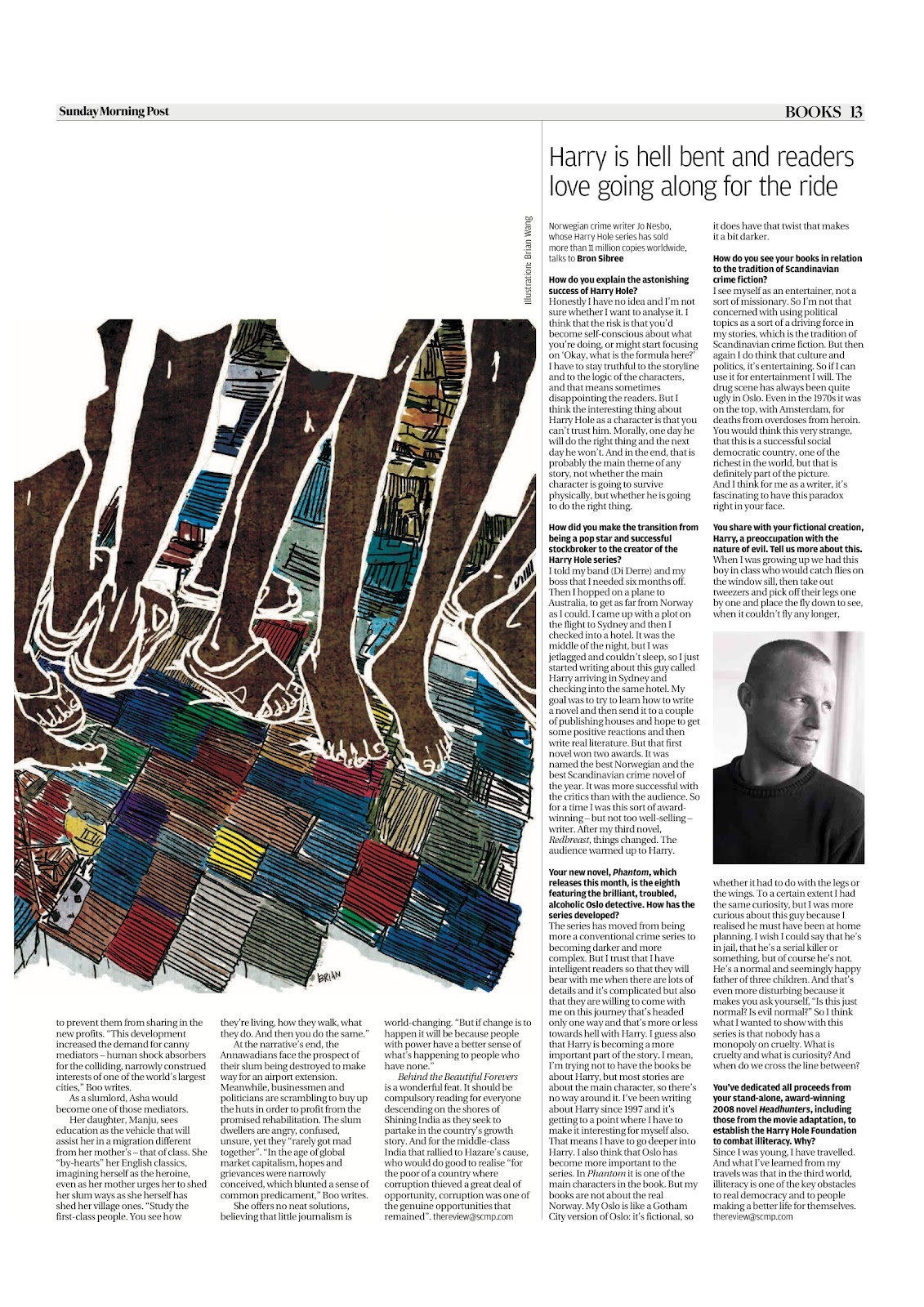
Review: Behind the Beautiful Forevers by Katherine Boo


I reviewed Behind the Beautiful Forevers for the South China Morning Post of Sunday, 19 February 2012.

In 2011 middle class India was in the throes of an anti-corruption movement headed by a Gandhian leader called Anna Hazare who was pressing for a stronger Jan Lokpal Bill, a People’s Ombudsman Bill. The movement against corruption stirred a middle class noted for its political apathy and blew like a whirlwind across the nation, gathering in its sweep social activists, Bollywood celebrities, and media people. 

As the mass agitation spread Hazare went on several fasts, using a tool Mahatma Gandhi had deftly deployed against the British during India’s freedom struggle – his topi, Gandhi cap, became a fashion statement as his supporters chanted ‘I am Anna’. 

Around the time of the first indefinite fast in Delhi Katherine Boo, an American journalist, was wrapping up three years of reportage from a Mumbai slum called Annawadi that nestled cheek-by-jowl with the international airport. From November 2007 Boo had documented the experiences of residents with written notes, video recordings, audiotapes, and more than three thousand public records – these obtained by diligent petitioning of government agencies under the RTI (Right To Information) act. 

The energetic and vociferous support that Hazare and his team galvanized took the Government by surprise. Corruption is endemic in India and Indians of all classes survive by giving and taking bribes. What had changed? 

Boo, though, wasn’t surprised. After her marriage to Sunil Khilnani, an Indian academician, she’d visited India, “an increasingly affluent nation that still housed one-third of the poverty, and one-quarter of the hunger, on the planet”. For years, she’d reported on the poor communities in the United States and in India, parallel questions had surfaced: what does it take to get out of poverty?

Thereafter, the Pulitzer prize-winning New Yorker staffer spent months at a stretch in boggy Annawadi where three thousand people were packd into 335 huts, as she sought to answer how ordinary low-income people – particularly women and children – negotiate the age of global markets. “What is the infrastructure of opportunity in this society? Whose capabilities are given wing by the market and a government’s social and economic policy? Whose capabilities are squandered?” 

India’s growth story had brought in its wake a frothy mélange: an increasingly affluent middle class, an intrusive media, migration from rural areas to the metropolises, and corruption scandals centred on perfidious politicians. Predictably, the affluent middle class, aided by a sensationalist media, stiffened its spine, found its voice and nailed corruption on self-serving politicos.

But while the pursuit of opportunity had aided the middle class, it had also exacerbated the existing inequalities. Behind the runaway success of Slumdog Millionaire, a British film about a young man from Dharavi slums of Mumbai who beats all odds to become fabulously wealthy, lay the reality of slums juxtaposed with luxury hotels, high rises with dumpsters, all of which emphasized the disparity between the rich and poor residents of the Indian financial capital, alternatively known as Slumbai. 

The title, Behind the Beautiful Forevers, derives from an advertisement for Italiante floor tiles on a concrete wall that barricaded Airport Road from the slum of Annawadi. The corporate slogan ran the wall’s length: BEAUTIFUL FOREVER BEAUTIFUL FOREVER.

The profound inequality reminded Boo of other modern cities. “The scholars who map levels of disparity between wealthy and impoverished citizens consider New York and Washington D.C., almost as unequal as Nairobi and Santiago. Why don’t more of our unequal societies implode?”

How did Boo – a blond Caucasian woman, unfamiliar with India or its languages – chronicle the lives of the Annawadians? With the help of translators and by compensating for her limitations “the same way I do in unfamiliar American territory: by time spent, attention paid, documentation secured, accounts cross-checked”. The white woman circus fell away in a couple of months as “residents had concerns more pressing than my presence”.

For a piece of first-class reportage, the book is written at the pace of a thriller, rocketing off with a scene of self-immolation triggered by a squabble between neighbours. However, it contains no rags-to-riches story, no dramatic flashpoints, and no Bollywood superstar strolls into the slum (as in Slumdog Millionaire). Taking us into the lives and daily struggles of three Annawadians – Abdul Husain, the garbage sorter; Asha the aspiring slumlord-cum-kindergarten teacher; Manju, who wants to be the first graduate from Annawadi – this narrative non-fiction engages with an intimate eye and abundant humanity.

There is a reason Boo chose these three protagonists. As every slumdweller knew, there were three main ways out of poverty: finding an entrepreneurial niche, as the Husains had found in garbage; politics and corruption, in which Asha placed her hopes; and education, which Manju cleaved to.


The teenaged Abdul is the oldest child in the Husain family and its primary breadwinner. A garbage trader who bought from the scavengers, his profit came from selling refuse to small recycling plants. His mantra is to avoid trouble, stay quiet, and work hard to make enough money to buy a plot of land away from Annawadi. Yet, an envious neighbour implicates him in murder that sends the unworldly man-boy hurtling through the hoops of police-jail-court. “The Indian criminal justice system was a market like garbage, Abdul now understood. Innocence and guilt could be bought and sold like a kilo of polyurethane bags”. 

Asha, who migrated to Mumbai when she married, truly grasps the opportunities of a globalizing economy where the wealthy blamed the slumdwellers for making the city filthy, even as the oversupply of labour kept the wages of their servants low; and the poor complained about the inequality and the boundaries erected by the wealthy to prevent them from sharing in the new profit. “This development increased the demand for canny mediators – human shock absorbers for the colliding, narrowly construed interests of one of the world’s largest cities”. As a slumlord Asha would become one of those mediators.

Her daughter Manju looks at education as the vehicle that’ll assist her in a migration different from that of her mother – that of class. She “by-hearts” her English classics, imagining herself as the heroine, even as her mother urges her to shed her slum ways as she’d shed her village ones. “Study the first-class people. You see how they’re living, how they walk, what they do. And then you do the same”.

At the narrative’s end, Annawadians face the prospect of their slum’s destruction to pave way for an airport extension. Meanwhile, businessmen and politicians start a scramble to buy up the huts in order to benefit from the promised rehabilitation. The slumdwellers are angry, confused, unsure, yet, they “rarely got mad together. In the age of global market capitalism, hopes and grievances were narrowly conceived, which blunted a sense of common predicament”. 

Boo offers no neat solutions, believing that very little journalism is world-changing. “But if change is to happen it will be because people with power have a better sense of what’s happening to people who have none”.

Behind the Beautiful Forevers is a wonderful feat. It should be compulsory reading for all those descending upon the shores of Shining India as they seek to partake in the country’s growth story. And for middle class India that rallied to the anti-corruption cause of Hazare – it’d be good for them to realize that “for the poor of a country where corruption thieved a great deal of opportunity, corruption was one of the genuine opportunities that remained”.   

There is a video of a panel discussion at the 2012 Jaipur Literature Festival with Katherine Boo that I'd recommend. The link is here.

Friday, 27 January 2012

Book review: Arundhati Roy's Walking With The Comrades

This review appeared in the Sunday Post of the South China Morning Post, 22 January 2012.


Walking with the Comrades
by Arundhati Roy
Penguin Books
3 stars
Manreet Sodhi Someshwar

In the blockbuster science fiction film Avatar humans have destroyed earth because of their unbridled capitalism. The over-populated and resource-depleted planet is besieged by natural cataclysms and man-made disasters, in the wake of which humans are scouring outer space for resources. In Pandora, an earth-like moon, they discover unobtanium, a precious source of energy supply that they seek. Here’s the rub. Pandora is the home of a humanoid species called Na’vi who live in a giant tree that sits on a vast store of unobtanium. To mine this resource humans will have to battle the Na’vi, destroy their way of life and upset the ecological balance on Pandora. Unless stopped, they’ll end up wrecking Pandora just as they have done the earth.

The enormous success of Avatar can be partially explained by our ambivalence about climate change and global warming: is our modern lifestyle wrecking the earth and leading us to doomsday? Are we fated to live in an urban ghetto, heavily militarized and devoid of flora and fauna – a “dying world”, as a character in Avatar says, where humans have “killed their mother”?

In Walking with the Comrades Arundhati Roy tackles the question head on. She spends time with the Maoist guerillas in the forests where they are battling Indian security forces, documents their armed resistance and raises the question: will global capitalism tolerate any societies existing outside of its realm of control?

In a globalising world one question has been raised with increasing frequency: is capitalism compatible with sustainable development? A one-line summary of the movie Avatar, it is a debate of considerable significance as our world population approaches 7 billion – can our environment take the strain of an ever-expanding economy and people? 

Walking with the Comrades is a collection of three essays published over time in the Indian news weekly Outlook. In the first, Mr. Chidambram’s War, Roy takes us to south Orissa, a state locked in battle between tribals called Kondh and the Indian government. P. Chidambram is India’s home minister and “CEO of the war”. In a scene that seems lifted from Avatar the Kondhs worship the low flat-topped hills of their home as living deities. The same hills, however, contain vast deposits of bauxite, which one of the biggest mining corporations in the world want to mine. Financial value of the bauxite deposits of Orissa is 2.27 trillion dollars (twice India’s gross domestic product, at 2004 prices). 

“Thirteen tones of rock and stone yield one tonne of bauxite. The ‘Red Mud’ in these stilling ponds is the toxic residue produced by the refining process in which bauxite is turned to aluminium.” Roy documents the devastation that mining would bring to south Orissa. “If the flat-topped hills are destroyed, the forests that clothe them will be destroyed too. So will the rivers and streams that flow out of them and irrigate the plains below. So will the Kondh.” The tribals believe that if they do not fight for their land, they’ll be annihilated. They have taken up arms and the Indian Government has announced Operation Green Hunt, a war against the ‘Maoist’ rebels headquartered in the jungles of central India.

So, who are the Maoists really? Roy answers this question in the second essay, Walking with the Comrades, which gives the book its title as well. Through a secret rendezvous in Dantewada, Chattisgarh, Roy is led into an area controlled by the Maoists. “It’s the epicenter of a war. It’s an upside-down, inside-out town. There the villages are empty, but the forest is full of people. The police wear plain clothes and the rebels wear uniforms”. 

The Maoists are members of the banned Communist Party of India (Maoist), one of the several descendents of the Communist Party of India (Marxist-Leninist), which led the 1969 Naxalite uprising in the Indian state of West Bengal. The Maoists adhere to violence believing it to be the only way to redress the innate structural inequality of India. In their current avatar, the Maoist insurrection has spread through the mineral-rich forests of central India, which are “homeland to millions of India’s tribal people, dreamland to the corporate world”.

In Dantewada Roy learns first hand of the war being fought between a government paramilitary force and “ordinary villagers armed with traditional weapons, backed by a superbly organized, hugely motivated Maoist guerilla fighting force with an extraordinary and violent history of armed rebellion”. 

Over several days of trudging through the forest during day and sleeping in makeshift beds at night, Roy meets several members of the guerilla group. Lal Salaam Kaamrid is the universal greeting: Red Salute Comrade. The comrades show her a deserted school building constructed like three octagons attached to each other like a honeycomb, to enable the police to fire in all directions. She learns the history of the resistance movement, how uniting the people has improved their bargaining power with corporates that operate out of the region, beedi makers, paper mills, the Forest Department. They are governed by an elaborate structure of Janatana Sarkars (people’s governments) and “the organizing principles come from the Chinese revolution and the national liberation struggle in Vietnam”.

Trickledown Revolution, the third essay takes a swipe at trickledown economics that propounds that economic benefits provided by government to businesses and the wealthy will benefit poorer members of society by improving the economy as a whole. Capitalists advocate that better technology and efficiency would lead to use of fewer resources even while increasing economic output. However, that central tenet of capitalism has come under fire in the face of rising inequality, dwindling social mobility and a denuding environment. In India it has resulted in a growth in armed uprising. “In Orissa, for instance, there are a number of diverse struggles being waged by unarmed resistance movements that often have sharp differences with each other. And yet, between them all, they have managed to temporarily stop some major corporations from being able to proceed with their projects”.

India’s experiment with capitalism is two decades old and its concomitant track record with sustainable development has been unreliable. During the construction of one of its biggest dams, the Sardar Sarovar Dam in Gujarat, every single thing that was protested against has happened. Displaced people have not been rehabilitated, canals have not been built, and most of the water is being guzzled by cities and big industry. 

The insurrection in the Indian tribal heartland poses a challenge to the government as it questions what constitutes progress and development. An award-winning writer, Roy has taken up the cause of the militant tribals with passion. Her publisher, Penguin, in a display of aggrandizement, describes her work as “full of earth-shattering revelations”. 


Several publications in India have been documenting this story. Roy's voice is an important addition to this debate. It would help if she could tone down the shrillness, avoid hyperbole and repetition, and use the considerable power of her pen to get both sides to the table.


Avatar might have ended with an all-out war that ended with a Na'vi victory, but that was on Pandora. We are on Earth, and need to find the right balance to survive.

Friday, 20 January 2012

A Writer is a Pugilist First! The Help and its lessons for writers

Book review: The Help by Kathryn Stockett


Recently I read The Help by Kathryn Stockett and came away gloriously satisfied. It is, in the finest sense of the term, a good old-fashioned read: a full-length novel (444 pages), an authentic setting, a cast of fully-realized characters, an engaging story with a heart.

This debut novel is set in Jackson, Mississippi, in southern USA in 1962 - a time when racial tensions run high and the dreaded KKK string up black men who even dare look a white woman in the eye.

Of course, the white households run on black help - men who work in the plantations and yards outside and women, in starched white uniforms, who cook, clean, polish, launder and manage white babies inside. The white men keep busy as plantation owners or corporate executives and the white women keep busier with bridge parties and charity balls.

The story revolves around three women: Aibileen, a black maid who lost her own son and is raising her seventeenth white child; Minny, another black maid, younger than Aibileen, mother of five children, a legendary cook, and feisty as a southern sun; and Skeeter, a 22-year-old white woman who has returned to Jackson after graduating, with ambitions to become a writer - if only her mother would stop getting her hitched to a man.

Skeeter, unhappy with the shabby manner in which her best friends - now married and running their own households - treat their black house maids, grieving the loss of the elderly maid who'd raised her since she was a baby, and searching for a riveting topic upon which to write and grab the attention of a senior editor in New York city, has a lightbulb moment: to give voice to Mammy.

Mammy was the black maid in the popular southern story, Gone With the Wind. Skeeter argues that nobody asked the devoted Mammy what she felt, and perhaps it was worthwhile examining what lay behind the stereotype? She broaches the idea to Aibileen who, predictably, shudders at the prospect. It is, after all, the era of the KKK.

So, which way will the pendulum swing? No spoiler here - read and discover for yourself! Rest assured, you'll be amply rewarded with hours of pleasure.

I cannot resist adding here that The Help also has help for aspiring writers and those working hard to get published. The book has been an incredible success - a New York Times bestseller for several months, it has sold five million copies! Followed swiftly by a film adaptation. Gulp!

But it didn't happen overnight. Kathryn Stockett had 60 rejections, turned down by as many literary agents. However, over those five years she wrote, edited, re-wrote the manuscript, refusing to give up.

A writer, I believe, is first and foremost a pugilist, who, after every knock, gets up and goes for it again. Ms Stockett got lucky with the 61st. However, as her editor Amy Einhorn - who runs her own imprint Amy Einhorn Books under Putnam - states, the book needed a complete overhaul and she accepted it only after the writer agreed to her conditions. Which meant,

a) it was back to the writing table for Ms Stockett

b) there was an editor who was doing her job, which is making a good manuscript great through the very essential skill of editing.

To Kill a Mockingbird is an all time classic. Yet, how many know that the manuscript was thoroughly overhauled by its editor and is practically unrecognizable from the final book? There was a time when editors did their job. Publishing has changed vastly since then. Most publishing houses, especially in India, want a fully-finished manuscript that is ready to roll off a printing press.

So, what are you doing on that floor? Get up, master the editing skill and add it to your arsenal of punches. And while we are at it: Do you have a broken nose to show for your endeavours?!

As Aibileen would say, in her lovely dulcet lingo, "There aint no writer without no pugilist first".