Since this is a post about writers, let's begin with a basic question:
Q: Why do writers write?
Mull over the thought as you read the post, the answer is at the bottom. Don't cheat and scroll down right away - I am curious what you come up with!
The Hong Kong International Literary Festival 2011 ran from 8 to 18 March with an extensive line up of writers from Amitav Ghosh to Benjamin Zephaniah.

I always enjoy the litfest - the venues are cosy-sized which means that the session can really be a tete-a-tete. Besides which it is a great chance for the audience to interact with these mysterious beings that chain themselves to their desks and emerge only at book launches and litfests. Or, more appropriately in the city of Mammon that is Hong Kong, to gawk at the weirdos who get by without doing anything useful with their time?!
I was lucky to moderate three events. The first, titled, The Dreamer, was with Rajeev Balasubramanyam.
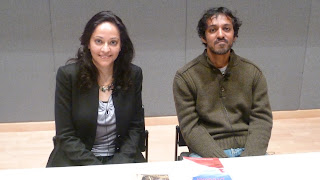


It is a writer's big dread - turning up and reading to an empty hall. Thankfully, we managed a Full House. Phew!

My second session, How to Survive the Modern World, with writers Rajeev Balasubramanyam and Xu Xi at the very chic Hullett House.

Er, in case the wine glasses give you the wrong impression, it's the correct one. As writers like to say, I'm a drinker with writing problems ...


Later in the day I caught up with Amitav and got my bagload of his books autographed! A lovely way to wind up the festival.

Nicholas Lezard said of litfests: "When you go see a band play live, you're watching it do on stage what it is meant to do. When you watch an author perform live, you are, most of the time, watching a dog walk on its hind legs." True Mr. Lezard but as they say in Hindi, marta kya na karta! Ah! the travails of a modern-day writer. On that note, here's the promised answer.
A: Because it isn't there!
Now tell me, what answer(s) did you come up with?
Post Script: Warning to potential writers. In case you get the (mistaken) impression from reading the above post that a writerly life is glamorous, here is a quote on the writerly profession from Monica Ali:
Writing is the hardest way of earning a living, with the possible exception of wrestling alligators.
As they say, forewarned is forearmed!
Q: Why do writers write?
Mull over the thought as you read the post, the answer is at the bottom. Don't cheat and scroll down right away - I am curious what you come up with!
The Hong Kong International Literary Festival 2011 ran from 8 to 18 March with an extensive line up of writers from Amitav Ghosh to Benjamin Zephaniah.

I always enjoy the litfest - the venues are cosy-sized which means that the session can really be a tete-a-tete. Besides which it is a great chance for the audience to interact with these mysterious beings that chain themselves to their desks and emerge only at book launches and litfests. Or, more appropriately in the city of Mammon that is Hong Kong, to gawk at the weirdos who get by without doing anything useful with their time?!
I was lucky to moderate three events. The first, titled, The Dreamer, was with Rajeev Balasubramanyam.


It is a writer's big dread - turning up and reading to an empty hall. Thankfully, we managed a Full House. Phew!

The HK litfest organizers treat their writers well - we ended the session with a late but leisurely Dim sum lunch at the HK Jockey Club's fancy Cantonese restaurant.
My second session, How to Survive the Modern World, with writers Rajeev Balasubramanyam and Xu Xi at the very chic Hullett House.

Er, in case the wine glasses give you the wrong impression, it's the correct one. As writers like to say, I'm a drinker with writing problems ...


The silvery-haired gentleman above is Amitav Ghosh and my 8-year-old who clicked these pics decided - considering the fan that her mum is of this writer - it would be wonderful to frame the shot in this manner :)
Third session was with Meira Chand, who is always a delight! Her sweeping Singapore saga, A Different Sky, was the focus of our discussion titled Hybridity at the genteel Helena May's Blue Room. If there's one place in HK where I'd love to sit and write, besides my study, it is this. The chintz, the blue paint, the hum of traffic and the old-world charm of this quaint colonial building in the heart of Central ...


Later in the day I caught up with Amitav and got my bagload of his books autographed! A lovely way to wind up the festival.

Nicholas Lezard said of litfests: "When you go see a band play live, you're watching it do on stage what it is meant to do. When you watch an author perform live, you are, most of the time, watching a dog walk on its hind legs." True Mr. Lezard but as they say in Hindi, marta kya na karta! Ah! the travails of a modern-day writer. On that note, here's the promised answer.
A: Because it isn't there!
Now tell me, what answer(s) did you come up with?
Post Script: Warning to potential writers. In case you get the (mistaken) impression from reading the above post that a writerly life is glamorous, here is a quote on the writerly profession from Monica Ali:
Writing is the hardest way of earning a living, with the possible exception of wrestling alligators.
As they say, forewarned is forearmed!


